
Contents
Introduction
Stars can be modelled as black body emitters as a result of the characteristic spectrum of electromagnetic radiation they emit.
In this post, we’re going to use the black body emitter model to explore the properties of stellar radiation and see how stars are classified by their spectral output.
Let’s begin!
Stars as black body emitters
A black body emitter is a theoretical object in thermodynamics that absorbs all electromagnetic radiation incident on it. It is called a ‘black body’ because it does not reflect any radiation.
Black body emitters also emit electromagnetic radiation at all frequencies, in a spectrum with the following characteristic shape.
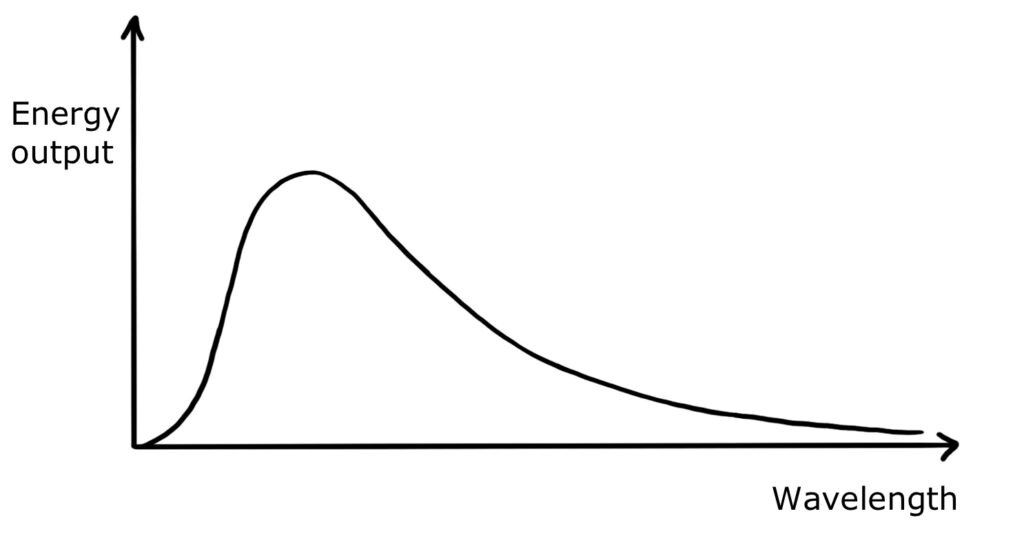
The wavelength at which the black body emits the most energy, as well as the total power output of the black body, can be calculated using thermodynamic laws for black body emitters.
Since stars behave as black body emitters to a good approximation, we can use these thermodynamic laws to model the spectral output of a star.
Wien’s law for the peak wavelength of a star
The wavelength at which a black body emits the most energy is its peak wavelength, \(\lambda_{max}\).
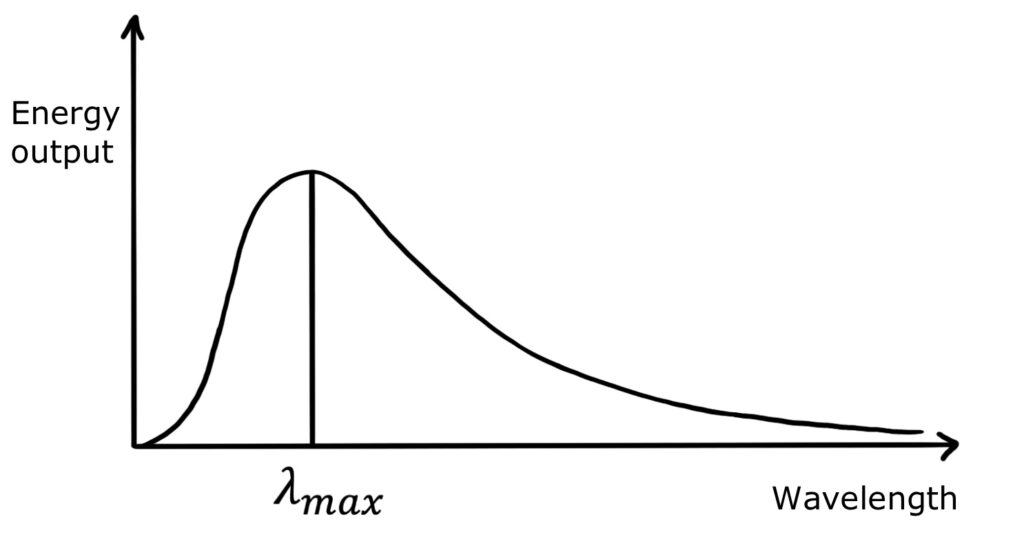
According to Wien’s law, a black body’s peak wavelength is inversely proportional to its surface temperature:
\(\lambda_{max}T =2.898\times10^{-3}\rm{mK} \)
The constant on the right hand side of the equation is Wien’s constant (in meters-Kelvin).
Applying this to stars, we can see that hotter stars which have higher surface temperatures have lower peak wavelengths. As surface temperature increases, the star’s emission spectrum shifts to the left towards the shorter wavelengths.
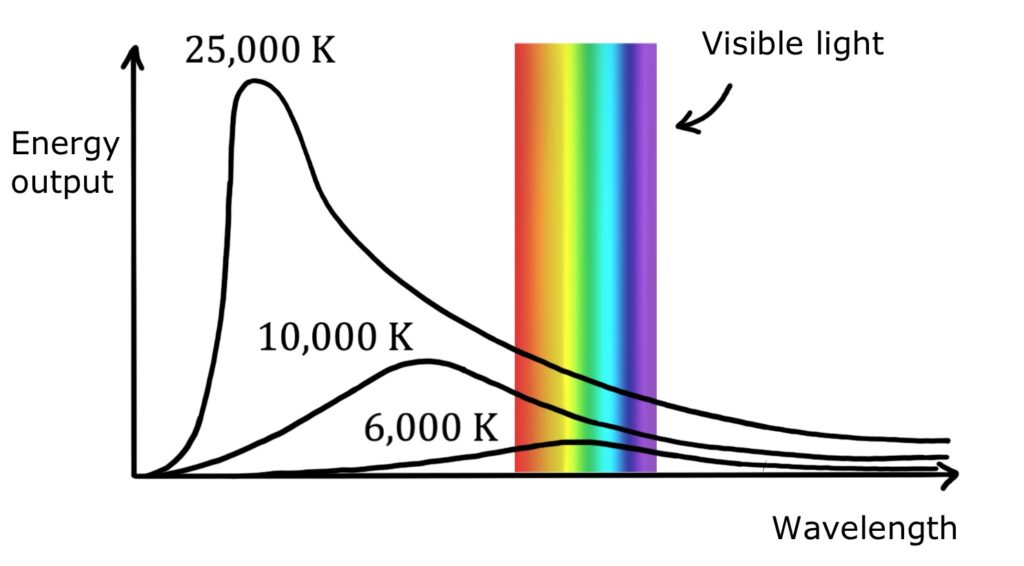
Wien’s law means that if we can observe the peak wavelength of a star’s output, we can calculate its surface temperature!
Classification of stars by spectral class
Stars have been classified into seven spectral classes based on their surface temperature.
The hotter stars look blue since their peak wavelengths are shorter, while the cooler stars look orange/red since their peak wavelengths are longer.
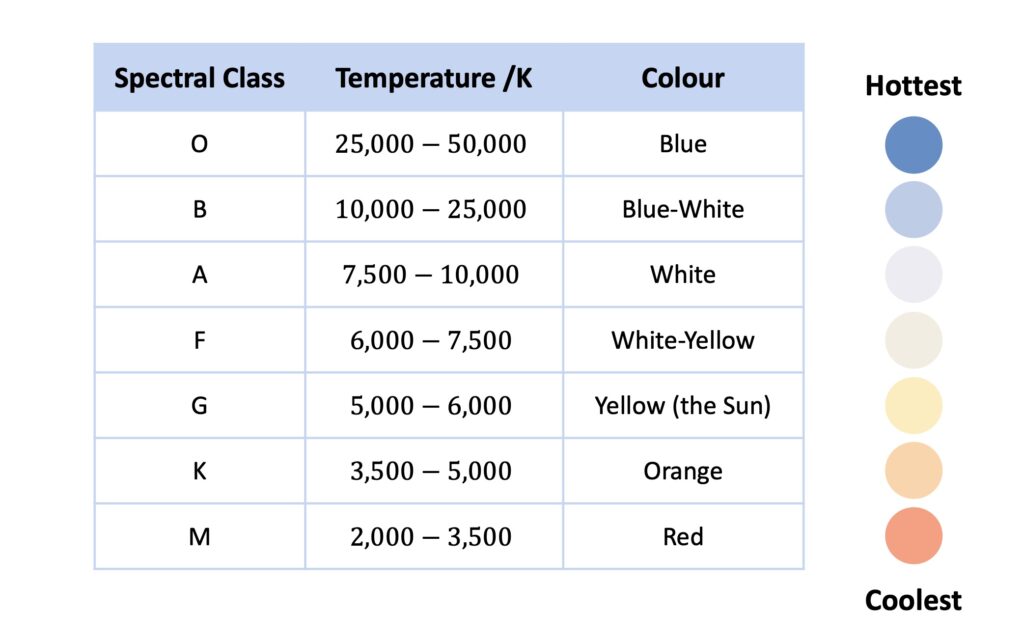
Our Sun, having a surface temperature of \(5,775\,\rm{K}\), looks yellow and belongs to spectral class G.
The letters of the seven classes follow the highly memorable mnemonic Oh Be A Fine Girl/Guy, Kiss Me.
The Stefan-Boltzmann law for total power output of a star
The Stefan-Boltzmann law provides an expression for the total power output, or luminosity, \(L\), of a black body emitter. The total power output is proportional to the black body’s surface area and to the fourth power of its surface temperature.
\(L=\sigma AT^4\)
The constant, sigma, \(\sigma\), is the Stefan-Boltzmann constant.
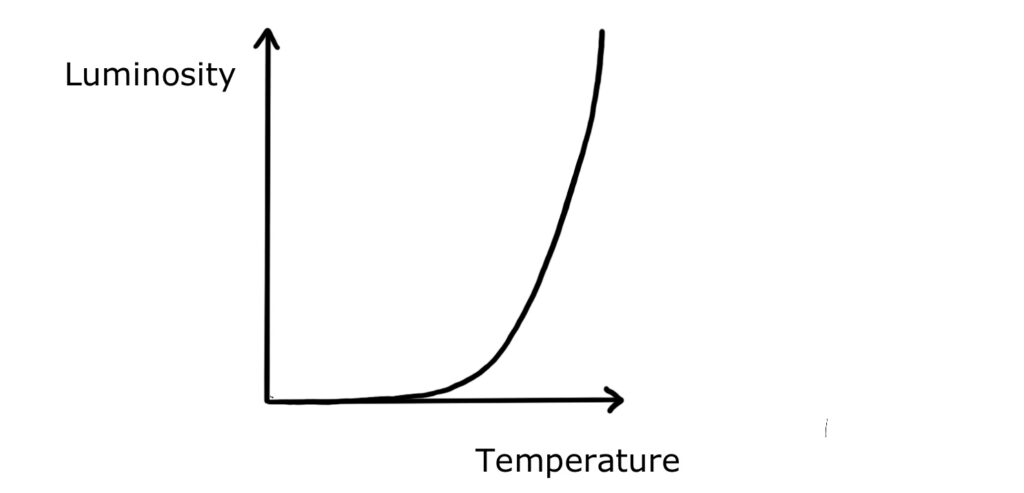
Applying this to stars, we can see that the dominant factor in a star’s luminosity is its surface temperature because of the fourth power.
Luminosity therefore increases rapidly with temperature for stars of the same size:
Very massive stars
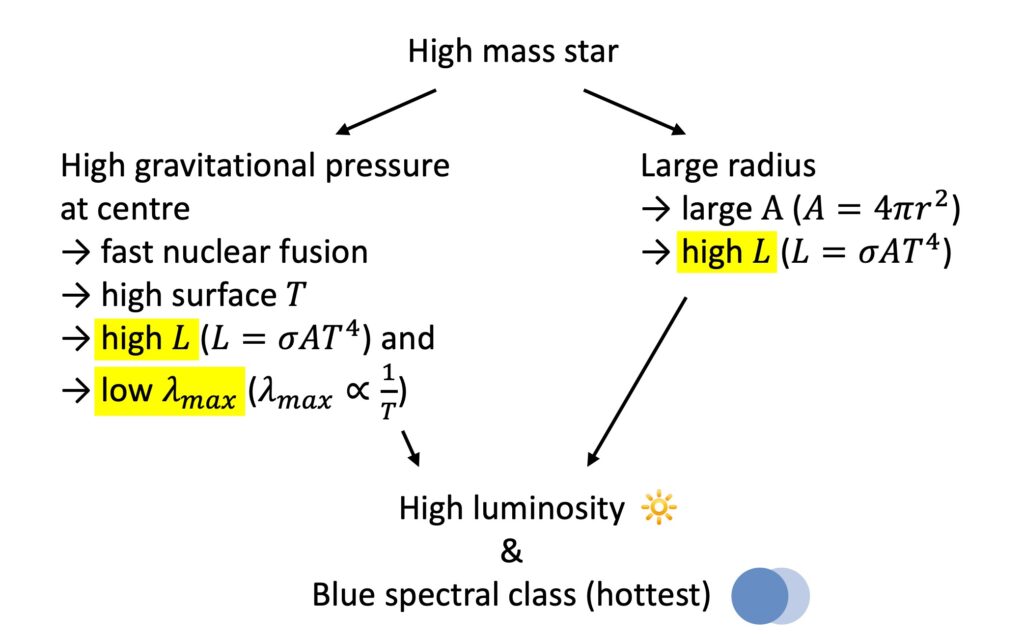
And finally, it is noteworthy that very massive stars tend to be the most luminous and also tend to occupy the hottest spectral classes.
Their high mass generates a high gravitational pressure at their centre, which leads to fast nuclear fusion and a high surface temperature.
Their high mass also generally means a large size, and therefore a large surface area.
From the Stefan-Boltzmann law (\(L=\sigma AT^4\)) and Wien’s law (\(\lambda_{max}T =2.898\times10^{-3}\rm{mK}\)), we see that the high surface temperature and high surface area result in:
- High luminosity
- Low peak wavelength, \(\lambda_{max}\) (blue spectral class)
Thus, the most massive stars tend to be the most luminous and to occupy the hottest spectral classes.
The total power output of the most massive stars is huge, and can be up to \(800,000\) times more than that of the Sun!
Conclusion
I hope you have enjoyed this review of stellar radiation! We have seen that stars can be modelled as black body emitters, with their surface temperature dictating their peak wavelength and heavily influencing their luminosity.
Now that you have reviewed this topic, you might like to explore the related and very interesting topics of the Doppler shift in starlight and nuclear fusion.
Happy studying!