
Contents
Introduction
Capacitors are nifty little electrical components that can be found in many electronic devices. Their purpose is to store electrical energy and release it rapidly.
In this post, we’re going to find out what capacitors are, how they store energy, and how to calculate the amount of energy they store.
Let’s begin!
What is a capacitor?
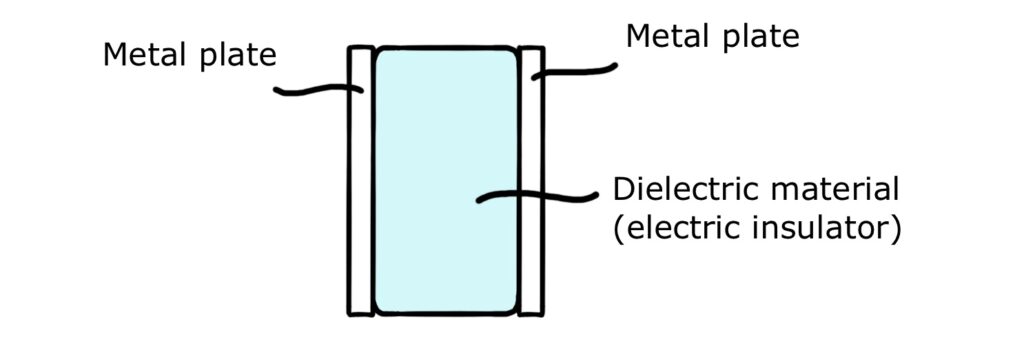
A capacitor is an electrical component that stores electrical charge. The simplest type is a parallel plate capacitor which has two parallel metal plates and a dielectric (insulating) material between them:
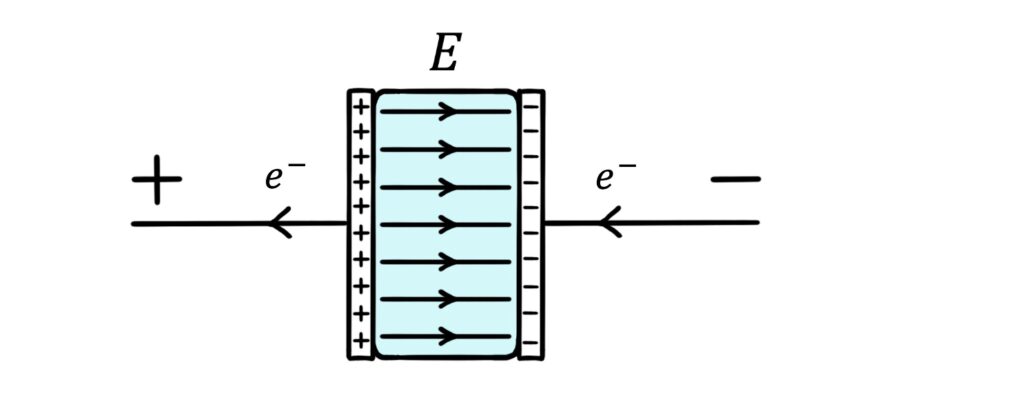
When the plates are connected to a power supply, a current flows around the circuit but cannot cross the dielectric material. Charge therefore accumulates on the plates, with one becoming positively charged and the other becoming negatively charged. As a result of the charges on the plates, a uniform electric field is established across the dielectric material:
The purpose of the dielectric layer
The dielectric layer is not solely for providing electrical insulation. It also helps to increase the amount of charge each plate can store.
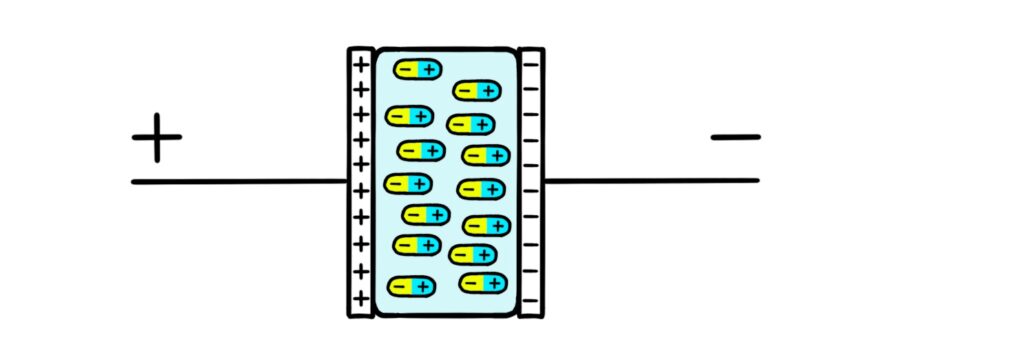
It is made from a special insulator that contains polar molecules, each of which has a positive end and a negative end.

When charge accumulates on the plates, the positive ends of the molecules are attracted to the negative plate and the negative ends of the molecules are attracted to the positive plate. This causes the molecules to rotate into alignment with the uniform electric field:
The positive and negative ends (or poles) of the molecules have tiny electric fields around them. However, the fields of adjacent positive and negative poles of neighbouring molecules cancel each other out:
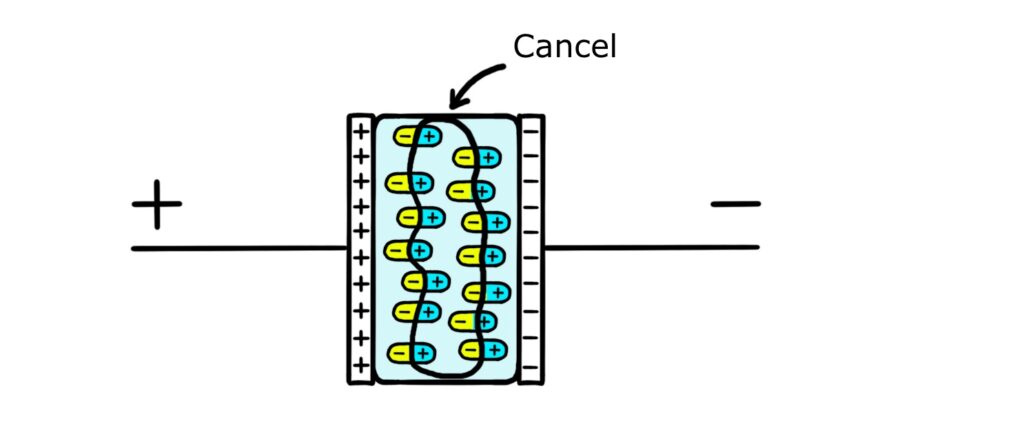
As a result, the only poles whose tiny electric fields remain un-cancelled are the negative poles on the far left and the positive poles on the far right:
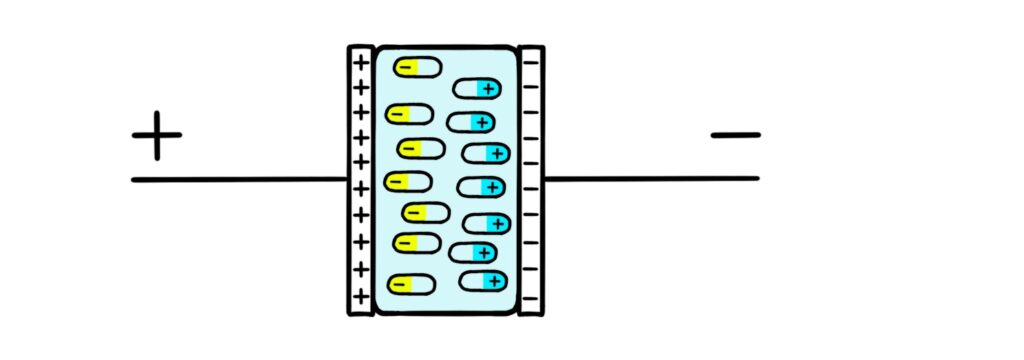
This arrangement gives the dielectric layer a negatively charged left surface and a positively charged right surface. The charged surfaces attract the charges that have accumulated on the plates, facilitating further accumulation of charge on the plates.
In an alternative arrangement, the molecules of the dielectric layer are not naturally polar, but become polar when placed in an electric field. The uniform electric field between the charged plates causes the electron cloud around each molecule to be attracted slightly towards the positive plate and away from the negative plate. This induces polarity in the molecules, which are sometimes referred to as ‘induced dipoles’. They work in the same way as the molecules that are permanent dipoles for increasing the capacitor’s ability to store charge.
Definition of capacitance
Capacitance is a measure of a capacitor’s ability to store charge. It is defined as the amount of charge a capacitor stores on each of its plates per volt of potential difference placed across it:
\(C=\frac{Q}{V}\)
While a capacitor is being charged, the potential difference \(V\) placed across the plates is increased from zero towards a final value. As the potential difference increases, so does the charge on each plate (according to \(Q=CV\)).
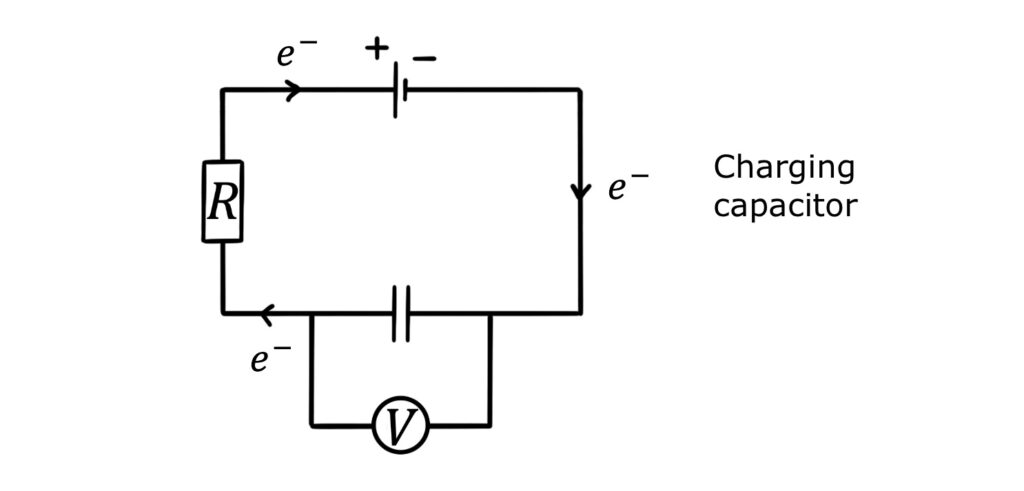
At the end of the charging process, a steady state is reached in which \(V\) and \(Q\) reach their final values and the capacitor is fully charged.

Energy stored in a capacitor
During charging, a graph of \(V\) against \(Q\) is a straight line through the origin because \(V=\frac{1}{C}Q\).
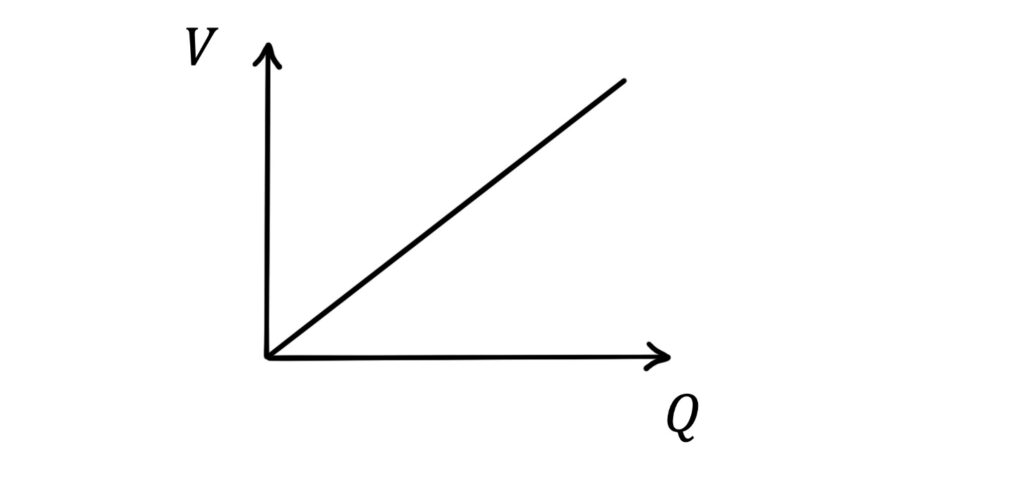
Let’s imagine a very short period of time during this charging process. During this period, a small charge \(q\) is added to the capacitor. The positive plate becomes more positive by \(+q\) and the negative plate becomes more negative by \(-q\). We have effectively moved a charge around the circuit from the negative plate to the positive plate through a potential difference of \(V\).
From our knowledge of electric fields, the work required to do this is:
\(\Delta W=q\Delta V\)
During the short period, \(V\) is also increasing so we need to use an average potential difference:
\(\Delta W=q\Delta V_{ave}\)
Since the work done during the short period is equal to \(q\) multiplied by the average potential difference \(\Delta V_{ave}\), it is equal to the area of the following rectangle:
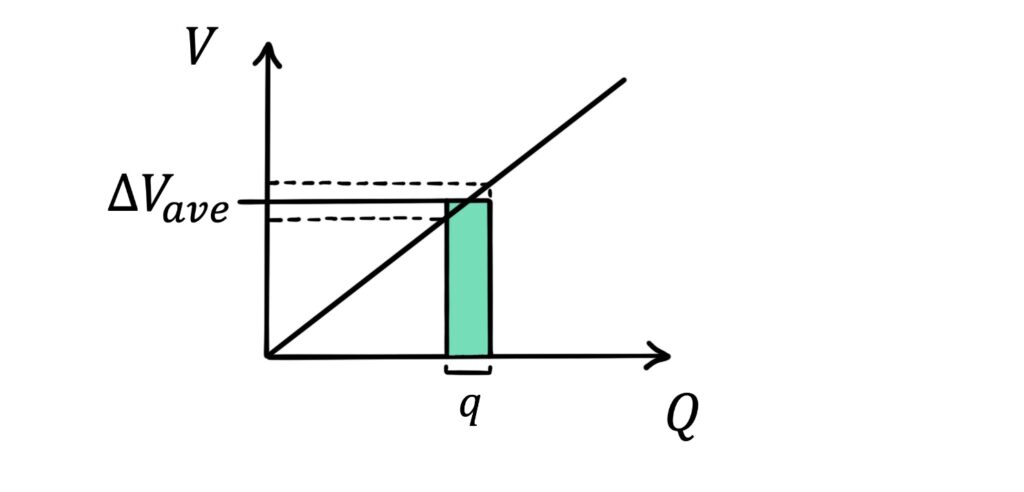
This is equivalent to the area of the following trapezium, which is the area under the graph:
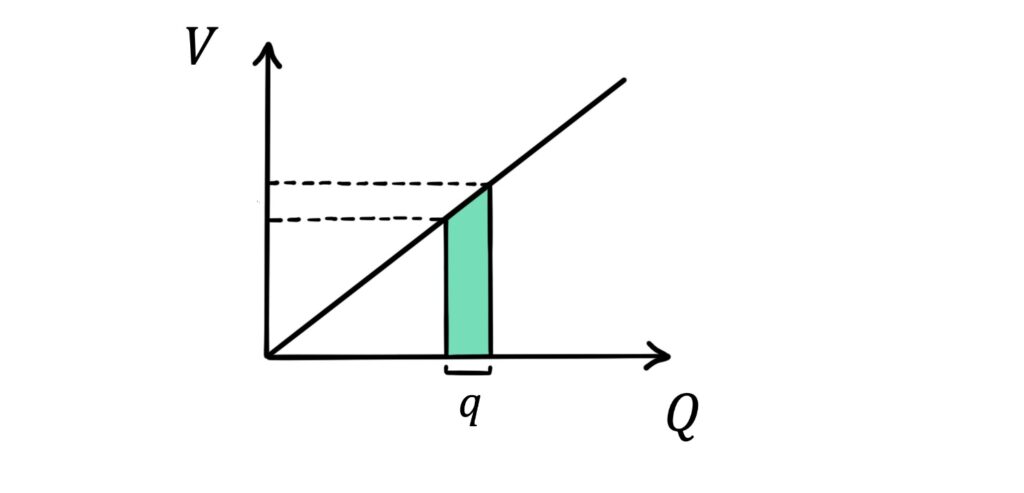
We can therefore conclude that the work done during the short period of the charging process is the area under the \(V\)-\(Q\) graph for that portion of the charging.
Extending this logic, the work done to fully charge the capacitor is sum of the work done during all the short periods which is the total area under the \(V\)-\(Q\) graph:
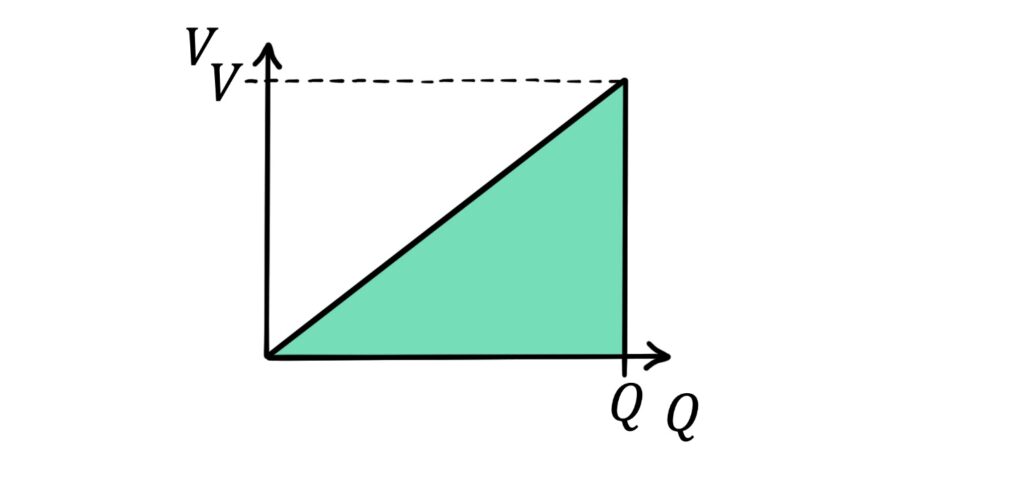
This is a right-angled triangle whose area is \(\frac{1}{2}base \times height\), so the energy stored by the fully charged capacitor is:
\(E=\frac{1}{2}QV\)
Since \(C=\frac{Q}{V}\), we can also express the energy stored in the following two ways:
\(E=\frac{1}{2}CV^2=\frac{1}{2}\frac{Q^2}{C}\)
Conclusion
I hope you’ve enjoyed learning about capacitors! We’ve covered their basic structure, how they store charge, and how much electric potential energy they can store.
If you enjoyed this topic, you might also like the related topics of capacitors in parallel and series and electric fields.
Happy studying!