
Contents
Introduction
When it’s time for revision, you will be brushing up on topics and honing your problem-solving skills for peak performance.
In this post, we’re going to look at how to spend your time wisely, so you have the best chances of success in exams.
Let’s begin!
How to plan your revision
The best way to revise is to use a method that is simple and reliable.
With this in mind, I recommend that you base your revision plan on these simple steps:
- Complete any remaining topic summaries
- Revise topics by spaced repetition
- Practice past papers
Throughout the school year, I suggest you create a quick topic summary after you complete each topic, as this will give you a helpful set of notes to revise from. Following this approach, the first step of revision is therefore to complete any remaining topic summaries that you missed out so that you have a complete set of summaries.
Ideally, you’ll complete your topics summaries in time for the Easter holidays.
The next stages are then to revise topics by spaced repetition and to start practicing past papers. These will take place during the Easter holidays and the summer term, and this block of time should be approximately equally split between the two stages.
Revising topics by spaced repetition
Revising topics by spaced repetition means revising each topic once and then returning to it multiple times, ideally at increasing intervals.
For example, you might revise mechanics for a first time, and then return to it 7 days later, return again after another 10 days, and return again after a further 15 days.
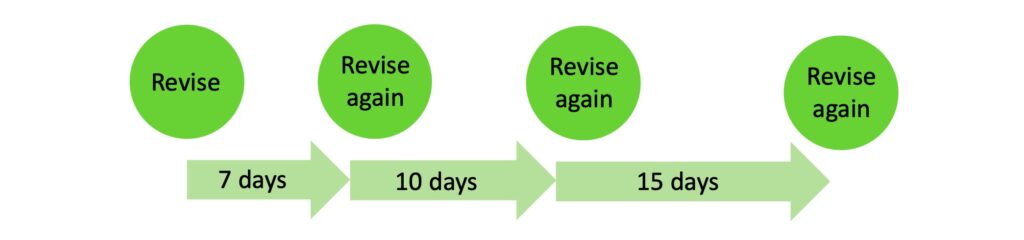
The exact timings don’t matter, but the principle is that each time you return to a topic, you push the content more firmly into your long-term memory. Since it gets lodged more securely, you can leave it for a longer time before returning to it again! This is an efficient method of revision.
When revising a topic, key activities should include:
- Reviewing your topic summary
- Testing recall of equations and facts from your summary
- Trying exam style questions and marking your answers
- Updating your topic summary with what you learnt
You can see that this process is iterative! Each time you revise a topic, you will improve your recall and learn some useful details. The goal is not to be perfect, but to incrementally grow your knowledge each time you visit a topic.
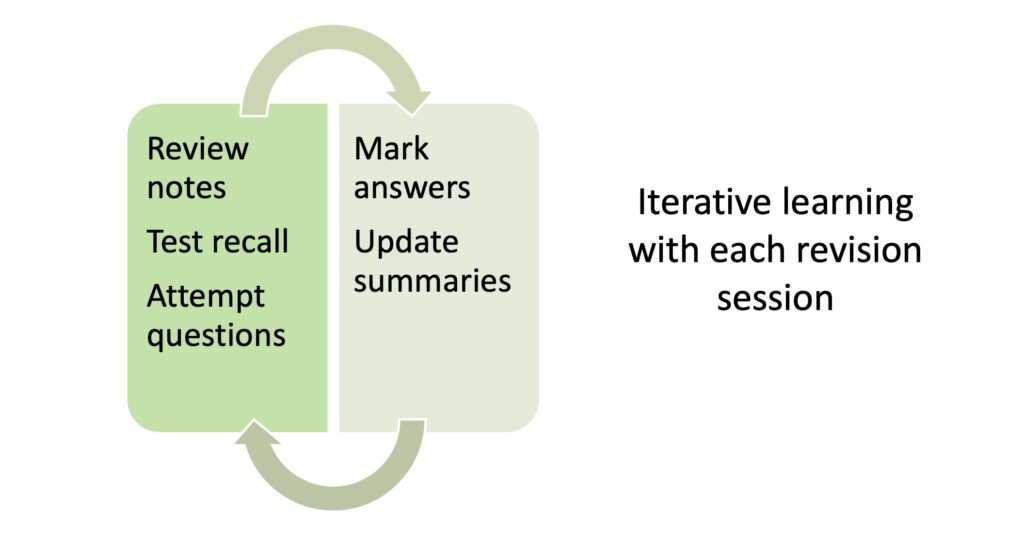
An important tip for your revision sessions is to spend the majority of your time on active study, not passive study. Passive study generally involves reviewing information (e.g. reading, highlighting notes), whereas active study involves applying it (e.g. testing recall, attempting exam style questions).
By focussing on active study, your brain will be more fully engaged and you will naturally improve your recall and problem-solving skills.
Don’t forget maths, practical skills and units! It’s easy to forget these, but they can give you easy marks and you’ll potentially lose marks in areas of physics that you know well if you don’t revise them. I suggest that you treat them as topics in their own right, so they can be included in your revision plan and not forgotten.
After about a month of revising topics by spaced repetition, your knowledge will be getting sharp. This is when you will be ready to start practicing past papers.
Practicing past papers
Practicing past papers for the first time represents a significant milestone. You will be tackling questions from a range of topics and testing your agility at interpreting questions and spotting the relevant physics.
Your goal is to learn a good batch of information with each past paper. The best approach is to attempt the whole paper, mark it strictly, and add what you learn to your topic summaries. This will give maximum benefit from each paper and capture your detailed learnings in your summaries.
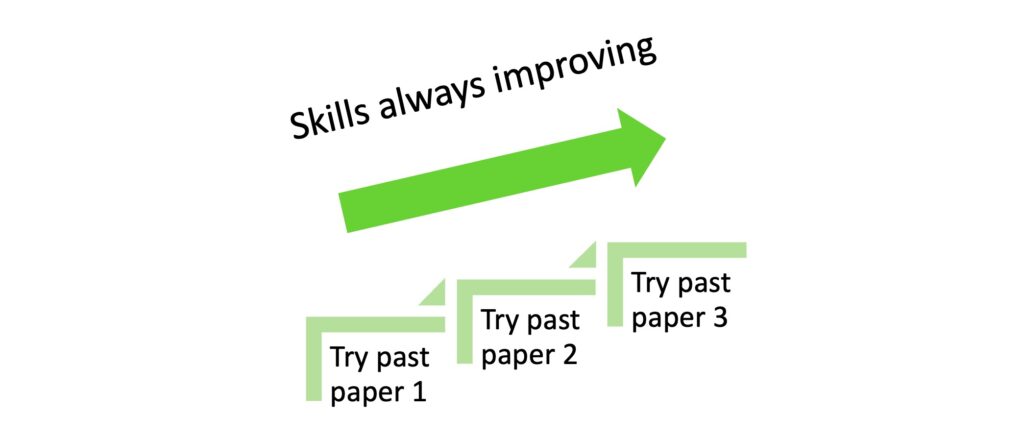
At first, it will take way longer than the allocated time for the exam to finish a paper. This is completely normal and you will get quicker, so don’t let this discourage you.
After a while, you will be ready to try past papers under timed conditions. A sensible aim is to do timed past papers in the last couple of, or few, weeks before exams.
Timed conditions will give you a feel for the pace and timing of the exam, and help you get used to tactics such as deciding when to move on from a tricky question and when to persevere. It’s generally best to use your available time for the questions you are stronger on, if possible.
In the same way as for untimed past papers, complete the paper, mark it strictly, and add what you learn to your topic summaries.
Final preparations the week before exams
You are nearly there! In the final week, all you need to do is review your topic summaries and attempt one, maybe two, timed past papers.
If there are topics you are weaker on, do not panic. I recommend that you focus on consolidating your knowledge in your stronger topics, and look to gain a basic understanding of any weaker areas. This should enable you to play to your strengths whilst picking up some basic marks in weaker areas.
Remember, revision does not go perfectly for anyone! There will always be areas of doubt or topics you wish you’d revised earlier. Your main priority in the final week is to consolidate your position and look after your wellbeing before the exam.
On exam day, try to put external pressures to one side and give yourself space to calmly consider the questions at hand. The light is at the end of the tunnel, and you will be having a well-earned break soon!
Conclusion
I hope you’ve enjoyed this post on revision! We have covered planning your revision, revising topics by spaced repetition, and practicing past papers. Is there a tip or approach that you will incorporate into your revision plan this year?
In the meantime, you might also like to review the related topics of how to get an A* in A Level physics and exam technique.
Happy studying!