
Contents
Introduction
Capacitors are important little devices that store electrical energy by holding accumulated charge on their metallic plates. They are charged by placing a potential difference across them, and are designed to hold as much charge as possible.
In circuits, capacitors can be provided either individually or in groups that exhibit collective behaviour.
In this post, we’re going to explore the composite behaviour of groups of capacitors, including their total capacitance and the total amount of charge they store.
Let’s begin!
Definition of capacitance
Capacitance is defined as the amount of charge a capacitor can store on each of its plates per volt of potential difference placed across it:
\(C=\frac{Q}{V}\)
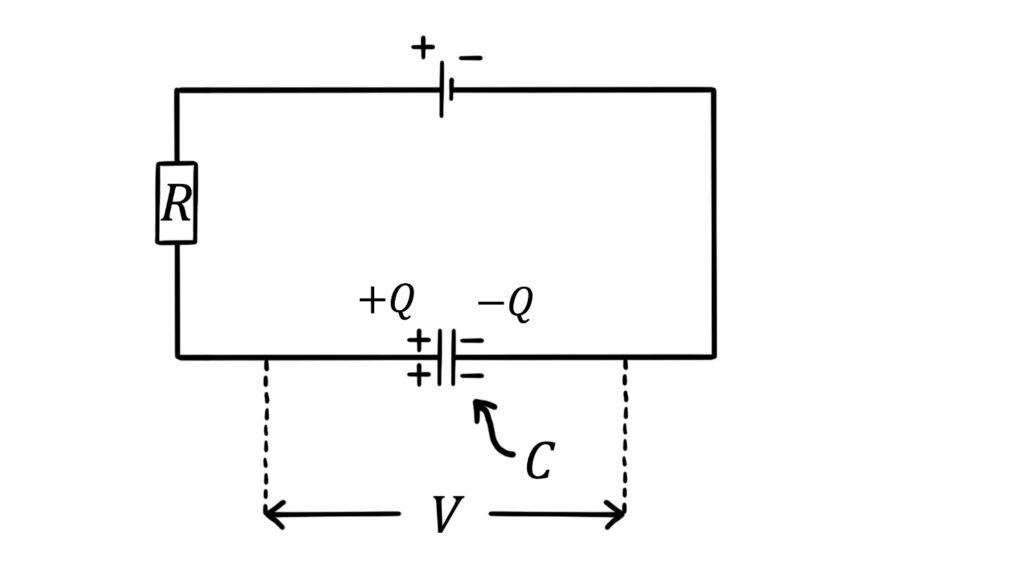
This means that for a given charging potential difference, a capacitor with a high capacitance will store a lot of charge, while a capacitor with a low capacitance will store only a little charge.
When multiple capacitors are combined, the total capacitance of the group can be increased by increasing the capacitance of one or more of the individual capacitors or by adding extra capacitors to the group.
However, the total capacitance of the group is not necessarily equal to the sum of the individual capacitances. To calculate the total capacitance, we need to take into account whether the capacitors are combined in parallel or in series.
Capacitors in parallel
When capacitors are in parallel, the potential difference, \(V\), across each capacitor is the same:
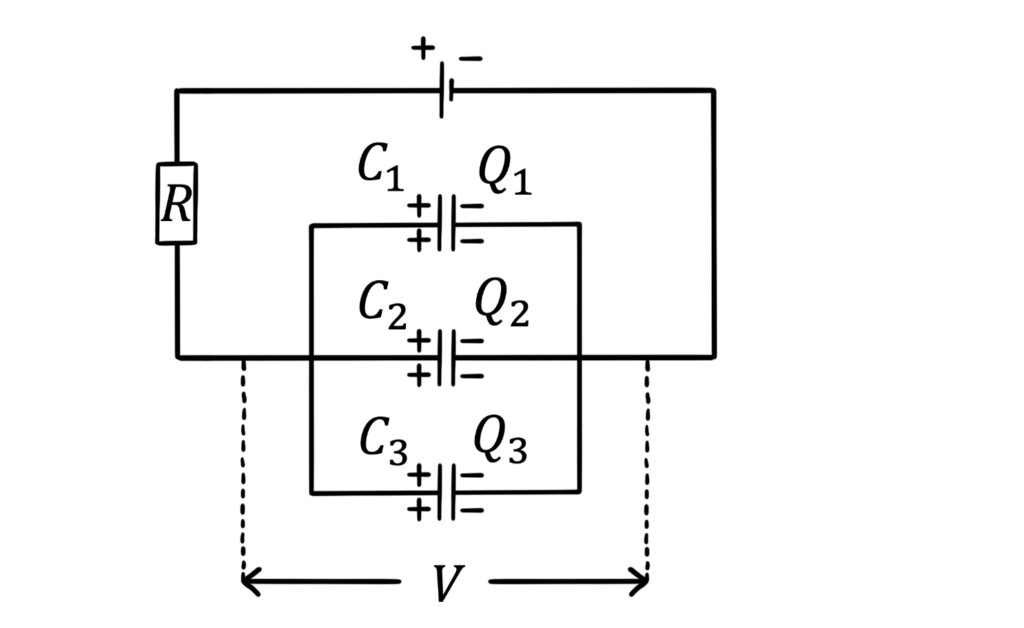
We can also see that the total charge stored by the parallel arrangement is the sum of the individual charges: \(Q=Q_1+Q_2+Q_3\).
These facts enable us to calculate the total capacitance of the group.
From the definition of capacitance above, we can say that the total capacitance is:
\(C=\frac{Q}{V}\)
where \(Q\) is the total charge stored by the capacitors and \(V\) is the potential difference across the group.
Since the total charge is \(Q=Q_1+Q_2+Q_3\) and the potential difference across the whole group is \(V\), we have:
\(C=\frac{Q_1+Q_2+Q_3}{V}\)
We can also write \(Q_1=C_1V\) etc for each capacitor because the potential difference, \(V\), across each capacitor is the same. As a result:
\(C=\frac{C_1V+C_2V+C_3V}{V}\)
This simplifies to:
\(C=C_1+C_2+C_3\)
As such, for capacitors in parallel the total capacitance is the sum of the individual capacitances!
In summary, for capacitors in parallel:
- Potential difference across each capacitor is the same
- Since \(Q_1=C_1V\) etc for each capacitor, the charge each capacitor stores depends on its capacitance
- Total charge stored is \(Q=Q_1+Q_2+Q_3\)
- Total capacitance is \(C=C_1+C_2+C_3\)
Capacitors in series
The story is a bit different for capacitors in series. When capacitors are placed in series, the potential difference across each capacitor is different:
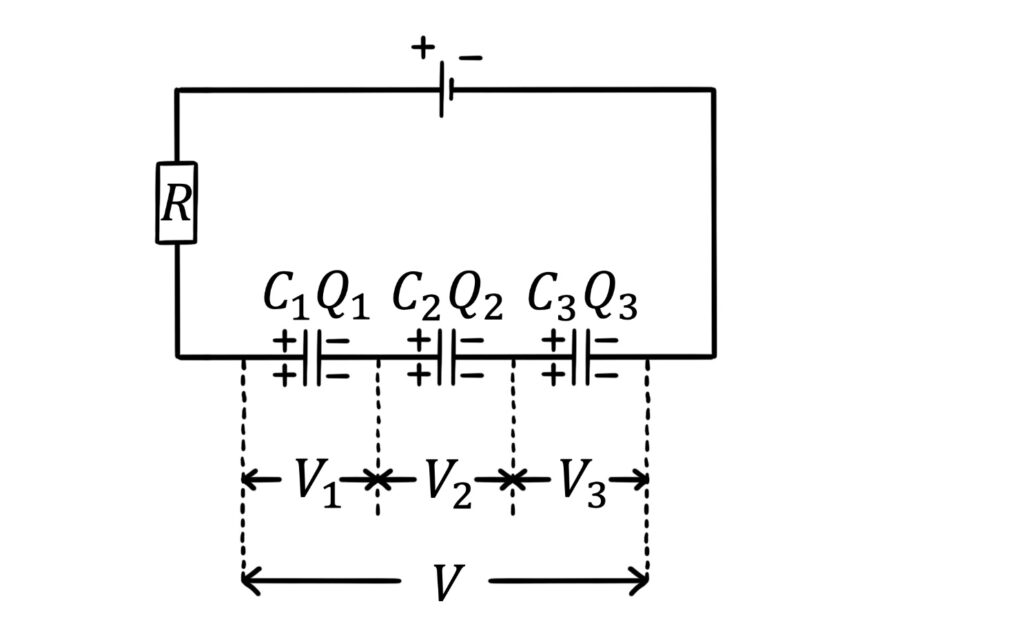
We can appreciate that the only capacitor plates that are actually connected to the circuit in this arrangement are the outermost plates (i.e. the left plate of capacitor 1 and the right plate of capacitor 3). This is because the other plates are electrically isolated from rest of the circuit by the insulating dielectric layers in the middle of each capacitor.
As a result, during charging the cell only directly charges the two outermost plates. The other plates acquire charges of equal magnitude by virtue of the attraction or repulsion of their electrons to or from the charged outer-most plates. (For example, electrons flow from the left plate of capacitor 2 to the right plate of capacitor 1.) All the capacitors therefore store the same amount of charge: \(Q_1=Q_2=Q_3\)
Since the only plates connected to the circuit are the outermost plates, the composite arrangement behaves like a single capacitor whose two plates are the outermost plates.
Consequently, the total charge stored by the group is equal to the charge stored on the outermost plates: \(Q=Q_1=Q_2=Q_3\)
Using these facts, we can now calculate the total capacitance of the group.
From the definition of capacitance above, we can say that the total capacitance is:
\(C=\frac{Q}{V}\)
where \(Q\) is the charge stored by the outermost plates and \(V\) is the potential difference across the group.
Since the potential difference across the group is \(V=V_1+V_2+V_3\) and the charge stored by the outermost plates is \(Q\), we have:
\(C=\frac{Q}{V_1+V_2+V_3}\)
Inverting both sides gives:
\(\frac{1}{C}=\frac{V_1+V_2+V_3}{Q}\)
Since the charge, \(Q\), stored by each individual capacitor is the same, we can write \(Q=C_1V_1\) etc for each capacitor, so:
\(\frac{1}{C}=\frac{Q/C_1+Q/C_2+Q/C_3}{Q}\)
This simplifies to:
\(\frac{1}{C}=\frac{1}{C_1}+\frac{1}{C_2}+\frac{1}{C_3}\)
So for capacitors in series, the inverse of the total capacitance is the sum of the inverses of the individual capacitances!
In summary, for capacitors in series:
- Potential difference across each capacitor is different
- Charge stored by each capacitor is the same: \(Q_1=Q_2=Q_3\)
- The group behaves like a single capacitor comprising the two outermost plates and storing charge \(Q=Q_1=Q_2=Q_3\)
- Since \(Q=C_1V_1\) etc for each capacitor, the pd across each capacitor depends on its capacitance
- Total capacitance is given by \(\frac{1}{C}=\frac{1}{C_{1}}+\frac{1}{C_{2}}+\frac{1}{C_{3}}\)
Other combinations
More complex arrangements are of course possible. These could include a parallel arrangement of series groupings, or a series arrangement of parallel groupings.
In such cases, the total capacitance of the sub-groups can be calculated first, and then these sub-groups can be combined to find the total capacitance of the arrangement as a whole.
Summary
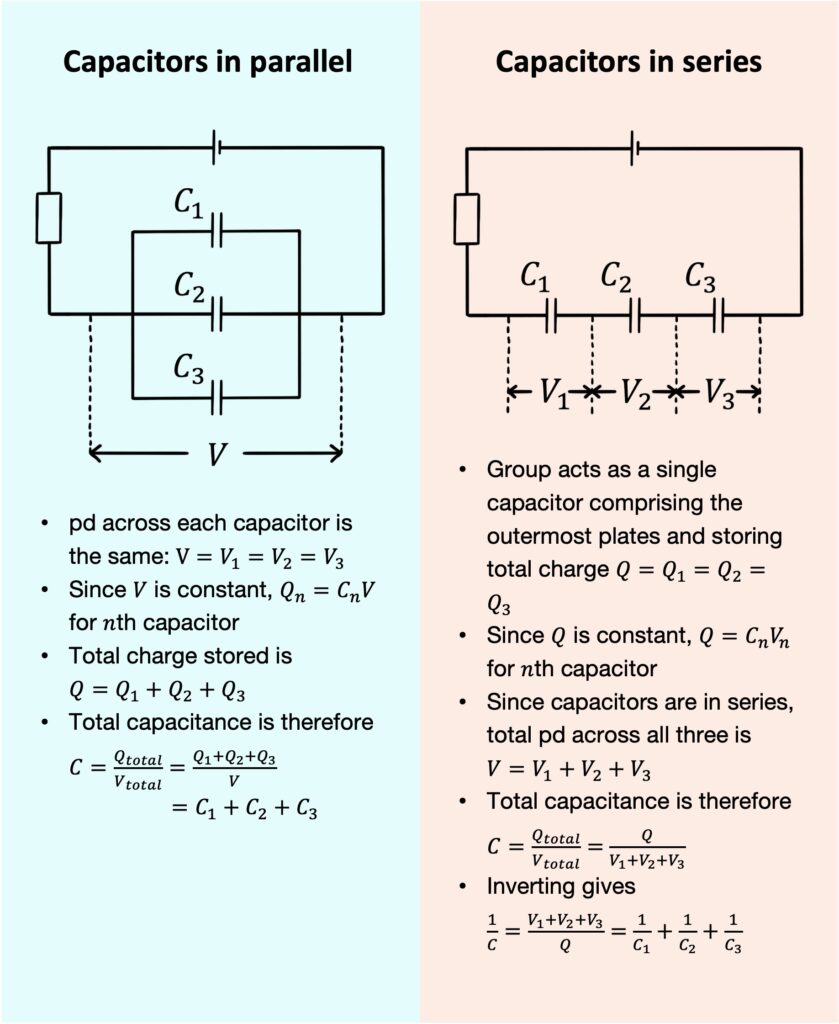
To bring everything together and easily compare capacitors in series and in parallel, here’s a summary of the key features of each:
Conclusion
I hope you’ve enjoyed learning about combinations of capacitors! We’ve covered the definition of capacitance and how to calculate the total capacitance of groups of parallel and series capacitors.
If you haven’t done so already, you might like to take a look at the structure of capacitors to find out how they are specially designed to store as much electrical energy as possible.
Happy studying!