
Contents
Introduction
A projectile is an object that is launched into the air and then travels freely under gravity.
In this post, we’re going to review the forces acting on a projectile and calculate some key parameters of its flight using the equations of motion.
Let’s begin!
What is a projectile?
A projectile is an object that is given an initial velocity and then moves freely under gravity.
For example, a ball or any object that is thrown or launched is a projectile. So are objects that are catapulted, hit, or fired into the air. Even water flowing off the edge of a roof exhibits projectile motion!
Once a projectile has been launched, there are two forces acting on it during its flight:
- Its weight under gravity
- Air resistance
For most projectiles, the force of air resistance is much smaller than its weight, so air resistance is comparatively negligible and can be ignored. In this approximation, the only force acting on the projectile is its weight:

Since the only force acting is weight, the projectile’s acceleration is the acceleration due to gravity: \(g=9.81\rm{ms^{-2}}\) downwards.
With a downwards acceleration, horizontal acceleration is zero. Horizontal velocity is therefore constant.
The combination of a constant horizontal velocity and a constant downward acceleration produces a curved path, which is the classic parabolic trajectory of a projectile.
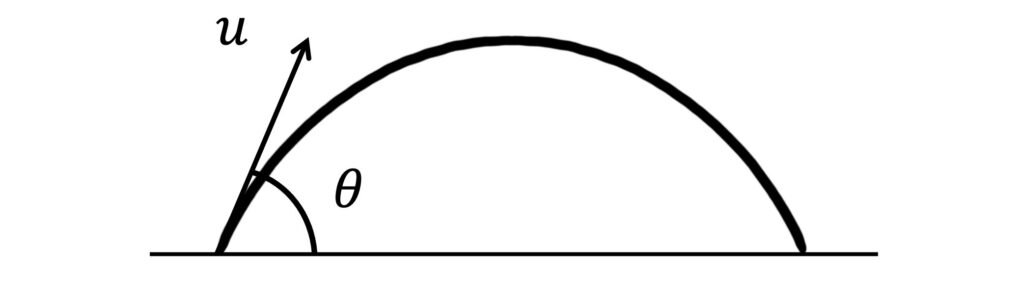
The independence of horizontal and vertical motion
In the horizontal direction, we can use the familiar equation displacement = velocity x time because horizontal velocity is constant:
\(s=ut\)
Meanwhile, in the vertical direction, we need to use the equations of motion for constant acceleration. These are called the ‘SUVAT’ (“soo-vat”) equations because they contain the following properties:
\(s\) displacement
\(u\) initial velocity
\(v\) final velocity
\(a\) acceleration
\(t\) time
The SUVAT equations are:
\(v=u+at\)
\(s=\frac{1}{2}(u+v)t\)
\(s=ut+\frac{1}{2}at^2\)
\(v^2=u^2+2as\)
The great thing about projectile motion is that there are only so many ways you can vary the initial conditions. As a result, once you have a good approach and have learnt the main tricks, calculations become quite straightforward!
Let’s try a few!
Calculating maximum height
A classic problem is to calculate the maximum height of a projectile.
For example, let’s say a projectile is launched with a speed of \(15\rm{ms^{-1}}\) at an angle of \(52^{\circ}\) to the horizontal, and we want to find the maximum height, \(h\).
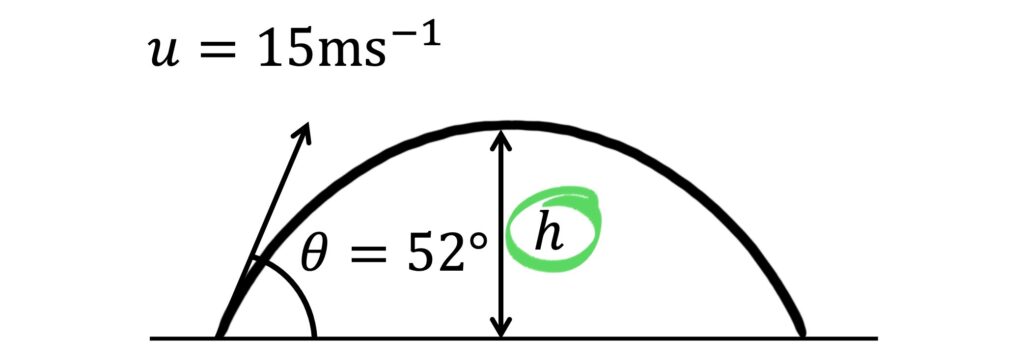
We know that when the projectile reaches its maximum height, its vertical velocity is zero (\(v_y=0\rm{ms^{-1}}\)).
So we know:
\(u=15\rm{ms^{-1}}\)
\(\theta=52^{\circ}\)
\(v_y=0\rm{ms^{-1}}\)
Therefore, the vertical motion has these conditions:
\(u_y=u\rm{sin}\theta=15\rm{ms^{-2}}\times sin52^{\circ}\)
\(v_y=0\rm{ms^{-1}}\)
\(a_y=-9.81\rm{ms^{-2}}\)
We want to find the maximum height, which is the vertical displacement, \(s_y\), but we don’t know the time taken to reach it. So we can summarise the knowns and unknowns as follows:

We need an equation that can give us \(s\) without needing \(t\):
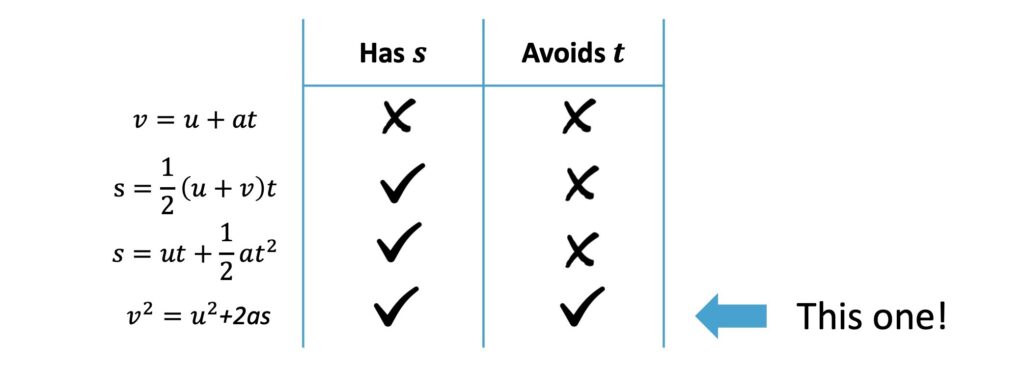
So we can use \(v^2=u^2+2as\)! Applying this to the vertical motion and rearranging for \(s_y\), we have:
\(s_y=\frac{v_y^2-u_y^2}{2a_y}\)
\(=\frac{(0\rm{ms^{-1}})^2-(15\rm{ms^{-1}}sin52^{\circ})^2}{2\times (-9.81\rm{ms^{-2}})}\)
\(=7.1\rm{m}\)
So the projectile reaches a maximum height of \(7.1\rm{m}\).
Calculating time of flight
We might be asked to find the time of flight for the same projectile.
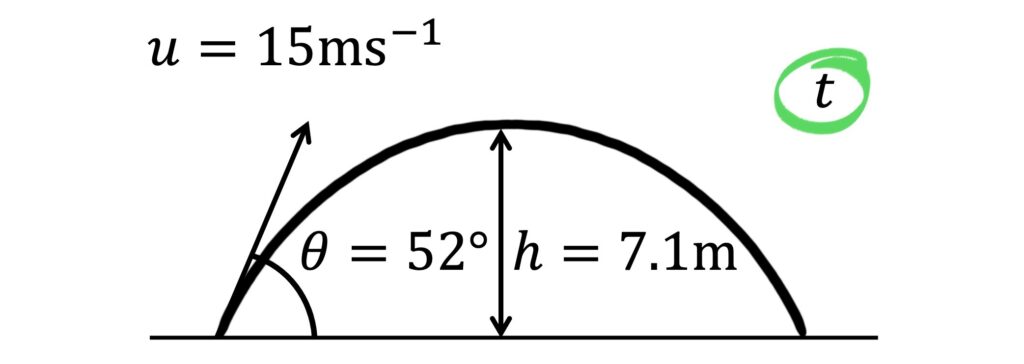
Since the flight path is symmetrical, we can find the time taken to reach the maximum height and double it. 🙂
Let’s consider again the vertical motion to the maximum height. We know the initial and final velocities and the acceleration, and we have already calculated the maximum height. So we know all the other quantities.

This means we have a pretty free choice as to which equation to use.
Let’s try \(v=u+at\).
Applying to the vertical motion and rearranging for \(t\), we have:
\(t=\frac{v_y-u_y}{a_y}\)
\(=\frac{0\rm{ms^{-1}}-15\rm{ms^{-1}}sin52^{\circ}}{-9.81\rm{ms^{-2}}}\)
\(=1.20490… \rm{s}\)
Remember, this is half the total flight time. Doubling this gives:
\(2t=2.40981…\rm{s}\)
So the projectile travels for \(2.4\rm{s}\).
Calculating range
Another key parameter we might be asked to calculate is the range, \(R\). This is the horizontal displacement, \(s_x\), of the projectile at the end of its flight.
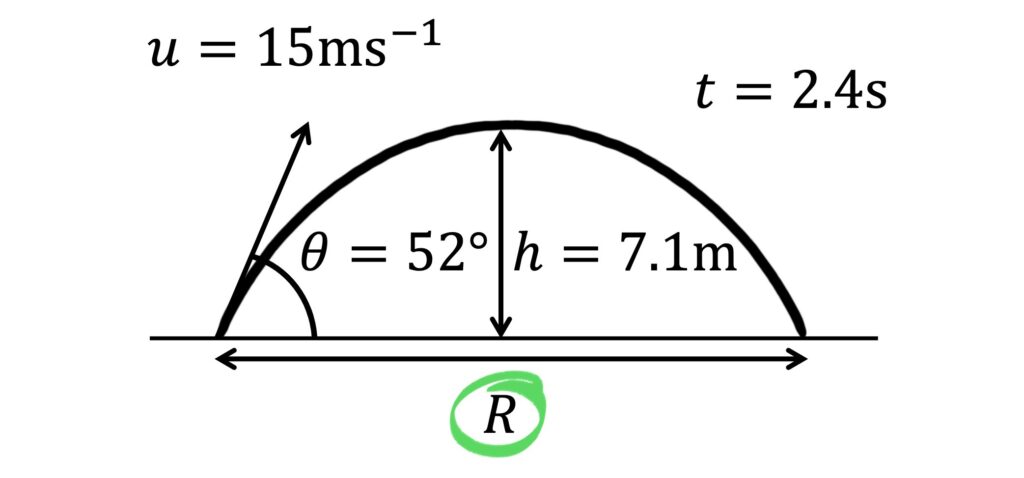
This one is super easy because we know the initial velocity and we have already calculated the time-of-flight. So we can use \(s=ut\) for the horizontal motion:
\(s_x=u_xt\)
\(=u\rm{cos}\theta \it{t}\)
\(=15ms^{-1}\rm{cos}52^{\circ}\times 2.40981…s\)
\(=22.25448…\rm{m}\)
And that’s it! The projectile has a range of \(22\rm{m}\).
Common projectile path shapes
Some projectile paths have interesting features that are worth being aware of. For example, some projectiles are:
- Launched from the same height as they land (classic shape)
- Launched from a height
- Land at a height
- Launched horizontally
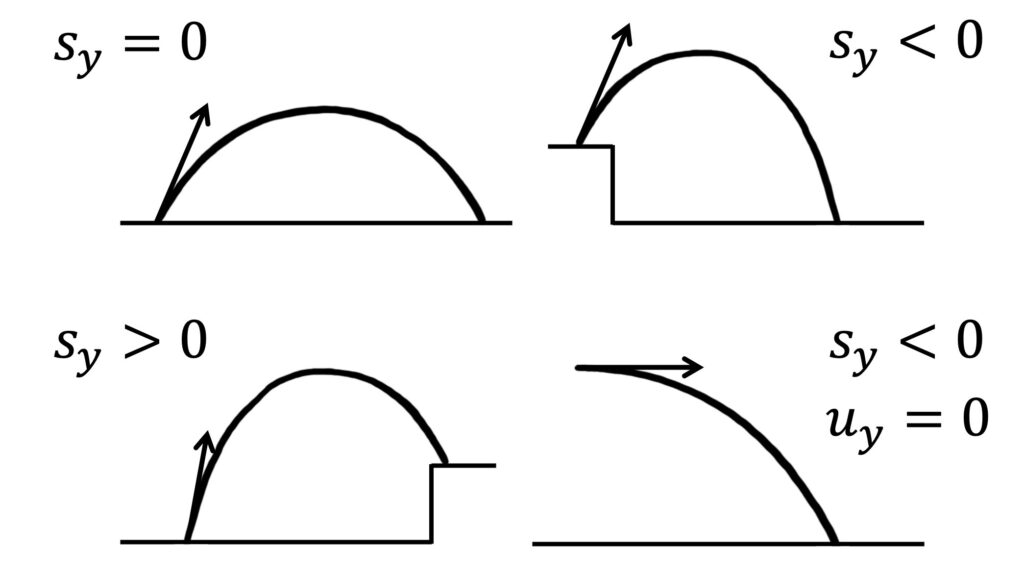
In the classic parabola shape, the projectile lands at the same height as it was launched. As a result, its vertical displacement for the flight is zero: \(s_y=0\).
By contrast, when a projectile is launched higher than it lands, the vertical displacement is negative: \(s_y<0\). If you get a negative vertical displacement in your calculations, don’t be alarmed!
Similarly, when a projectile lands higher than it was launched, its vertical displacement is positive: \(s_y>0\).
Finally, projectiles that are launched horizontally have two special features. The vertical component of their launch velocity is zero, \(u_y=0\), and their vertical displacement is negative, \(s_y<0\).
These features can be useful when solving various projectile motion problems.
Also remember that, for all projectiles, vertical velocity is zero when they reach their maximum height.
The effects of air resistance on projectile motion
Regardless of the overall shape of a projectile’s path, there will always be some effect from air resistance, even if very small.
You will not need to take air resistance into account in calculations, but you should be aware of the qualitative effects of air resistance on a projectile.
Air resistance is a drag force that acts in the opposite direction to the projectile’s velocity and increases with the projectile’s speed.
It slows the projectile and has three main effects on its trajectory:
- Maximum height is reduced
- Range is reduced
- Angle of descent is steepened
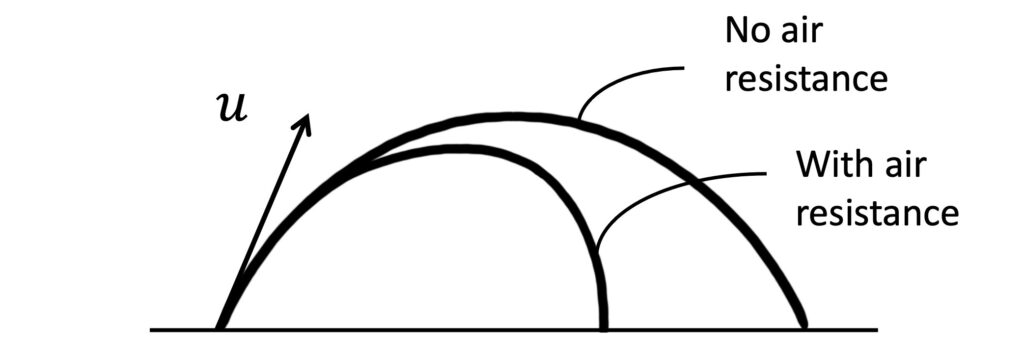
These effects are shown here in exaggerated form but for objects with a large surface area these effects can be significant!
Conclusion
I hope you’ve enjoyed this post on projectile motion! We have explored the forces acting on a projectile, the shape of its trajectory, and the separation of its vertical and horizontal motion.
If you’ve enjoyed this, you might also like to explore the principles of mechanics and graphs of motion for key scenarios.
Happy studying!