
Contents
Introduction
Mechanics is a fascinating topic concerning the motion of objects and their interactions with each other via forces.
In this post, we’re going to review the principles of mechanics so you have a strong grasp of the foundations of this topic.
Let’s begin!
Derivation of the kinematics equations
The kinematics equations for uniform acceleration— also known as the equations of motion— describe the relationships between the following properties of a moving object:
- Displacement, \(s \,(\mathrm{m})\)
- Initial velocity, \(u \,(\mathrm{ms^{-1}})\)
- Final velocity, \(v \,(\mathrm{ms^{-1}})\)
- Acceleration, \(a \,(\mathrm{ms^{-2}})\)
- Time, \(t \,(\mathrm{s})\)
They are also known as the ‘SUVAT’ equations because of the properties they contain.
While you don’t need to know their derivations, I’m going to take you through their derivations briefly so you can see the origin of these equations is non-scary and very logical!
Let’s start with an easy one. For an object moving with uniform acceleration, we know that velocity increases by \(at\) in time \(t\). The final velocity is therefore the initial velocity plus \(at\). This gives us the first equation of motion!
\(v=u+at\)
Another fact we know intuitively is that the displacement travelled during time \(t\) is the average velocity multiplied by time. Since acceleration is constant, the average velocity is \(\frac{1}{2}(u+v)\). So the displacement is:
\(s=(\frac{u+v}{2})t\)
Two down, two to go!
Let’s substitute \(v\) from the first equation into the second equation to get another expression for displacement:
\(s=(\frac{u+u+at}{2})t\)
\(=\frac{2ut+at^2}{2}\)
\(=ut+\frac{1}{2}at^2\)
This gives us the third equation of motion:
\(s=ut+\frac{1}{2}at^2\)
Finally, let’s find an equation without \(t\). To achieve this, we can rearrange the second equation of motion for \(t\), and substitute this expression into the first equation of motion. Rearranging \(s=(\frac{u+v}{2})t\) for \(t\) gives:
\(t=\frac{2s}{u+v}\)
Substituting this into \(v=u+at\) gives:
\(v=u+a(\frac{2s}{u+v})\)
\(\implies(v-u)(u+v)=2as\)
\(\implies vu+v^2-u^2-uv=2as\)
This gives us our fourth and final equation of motion:
\(v^2=u^2-2as\)
Here are the four equations together, and you know their origin is nice and straightforward:
\(v=u+at\)
\(s=\frac{1}{2}(u+v)t\)
\(s=ut+\frac{1}{2}at^2\)
\(v^2=u^2-2as\)
Newton’s 1st law of motion
Let’s now turn to Newton’s laws of motion to consider how the forces acting on an object affect its motion.
Newton’s first law of motion states that:
An object will remain in a state of uniform motion or rest until acted on by a resultant force.
In other words, if there is no resultant force acting on the object, its motion will continue at a constant velocity. Notice that this does not necessarily mean there are no forces acting on the object. It just means there is no resultant force. There could be multiple forces acting on the object that cancel each other out, resulting in equilibrium and a resultant force of zero.
Newton’s 2nd law of motion
Newton’s second law of motion states that:
The resultant force acting on an object is equal to the object’s mass multiplied by its acceleration.
This is our familiar friend, \(F=ma\)!
In this equation, \(F\) is not just any force acting on the object, but rather the resultant force. We can see that Newton’s first law is really a special case of the second law when the resultant force is zero. (When \(F=0\), \(a=0\), so the object’s velocity remains constant).
Newton’s 3rd law of motion
Newton’s third law of motion is a bit different. It states that:
When a first object exerts a force on a second object, the second object exerts an equal and opposite reaction force on the first object.
These two forces are often called a ‘Newton pair’ of forces. Apart from being in opposite directions, they are equal in all other ways, including that they are forces of the same type (e.g. both gravitational attraction or both electrostatic attraction/repulsion).
We need to be careful when identifying Newton pairs of forces. For example, weight and a normal force acting on an object are equal in magnitude and opposite in direction, but they are not a Newton pair!
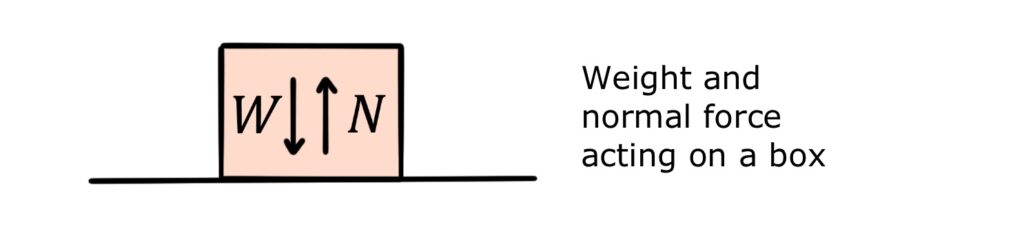
They are not a Newton pair because the forces are not of the same type and they act on the same object, not different objects.
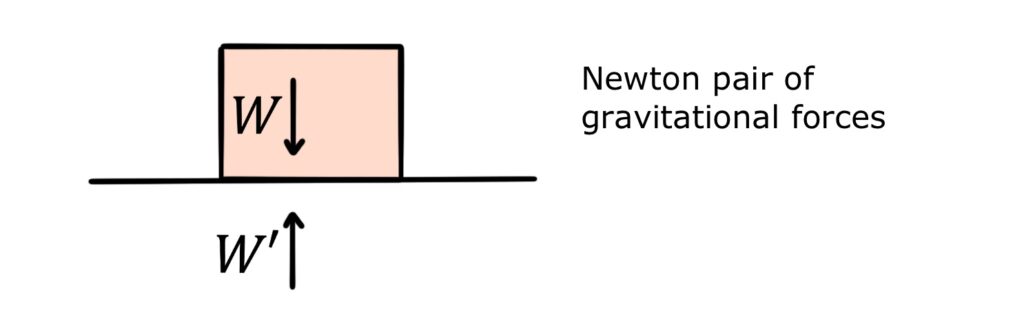
Indeed, the box’s weight is due to its gravitational attraction to a second object, the Earth. Therefore, there is an equal and opposite gravitational attraction exerted by the box on the Earth. Together, the two gravitational forces form a Newton pair:
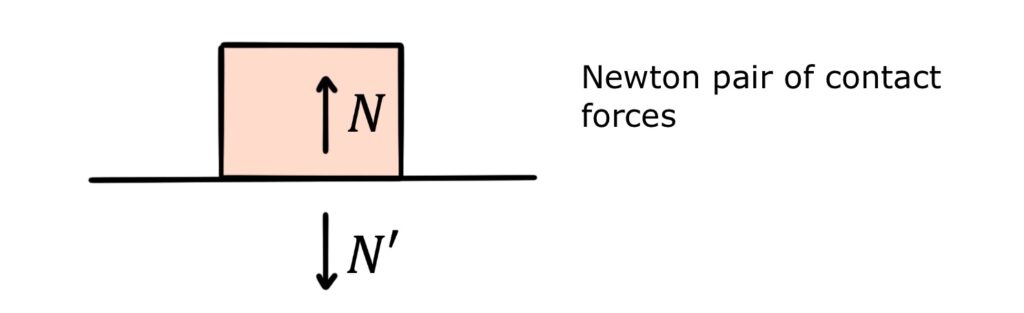
Similarly, the normal force supporting the box is a contact force arising from electrons at the edge of the surface electrostatically repelling electrons at the edge of the box. There is an equal and opposite contact force exerted electrostatically by the box on the Earth. These two contact forces form another Newton pair:
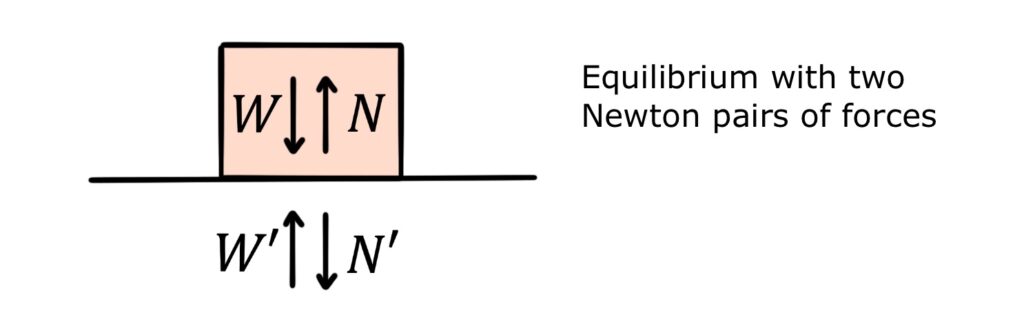
In this particular case, the box is stationary so the system is in equilibrium and the resultant force on each object is zero:
\(F_{box}=W+N=0\)
\(F_{earth}=W’+N’=0\)
Conservation of momentum
The conservation of momentum is an important fundamental principle in physics. It states that in the absence of external forces, the total momentum of a system is conserved.
This principle is often applied in the context of explosions and collisions.
It has a special relationship with Newton’s third law of motion. In fact, it is implied by Newton’s third law!
Starting with Newton’s third law, we know that interacting objects exert equal and opposite forces on each other (\(+F\) and \(-F\)).
Since \(F=ma\) (Newton’s second law) and momentum is \(p=mv\), force is equal to the rate of change of momentum:
\(F=ma\)
\(=m\frac{dv}{dt}\)
\(=\frac{dp}{dt}\)
So if two interacting objects exert a pair of Newton forces \(+F\) and \(-F\) on each other during time \(\Delta t\), their changes in momentum are \(+\Delta p\) and \(-\Delta p\). The total change in momentum of the system is therefore zero, and momentum is conserved:
\(\Delta p_{total}=+\Delta p-\Delta p=0\)
As such, Newton’s third law of reaction forces implies the conservation of momentum.
Work done
Finally, work done is the energy transferred to an object by a force acting on the object to make it move along a displacement.
\(work=force \times \, displacement\)
This force is the force that causes the displacement. For example, the work done by force \(F\) pulling a trolley a displacement \(s\) is:
\(work=Fs\)
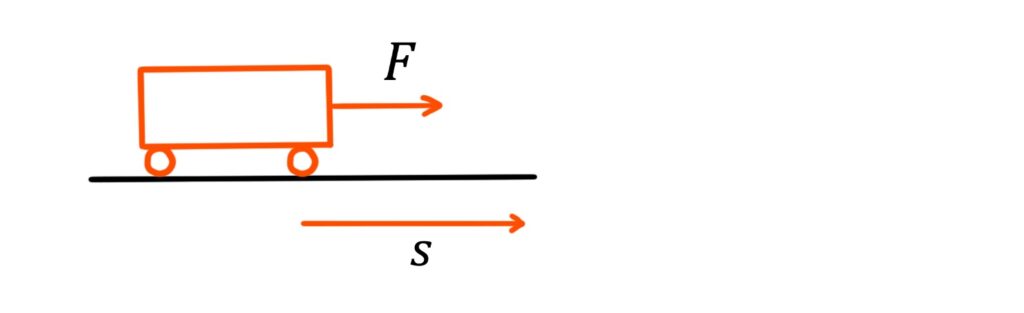
If the force is at an angle to the displacement, we need to resolve it in the direction of the displacement (because the force must be acting along the displacement):
\(work=Fscos\theta\)

All other forces on the trolley (such as friction, weight and air resistance) can be ignored because they are not the ones doing the work of moving the trolley. The only force you need to use when calculating the work done is the force that causes the displacement.
Summary
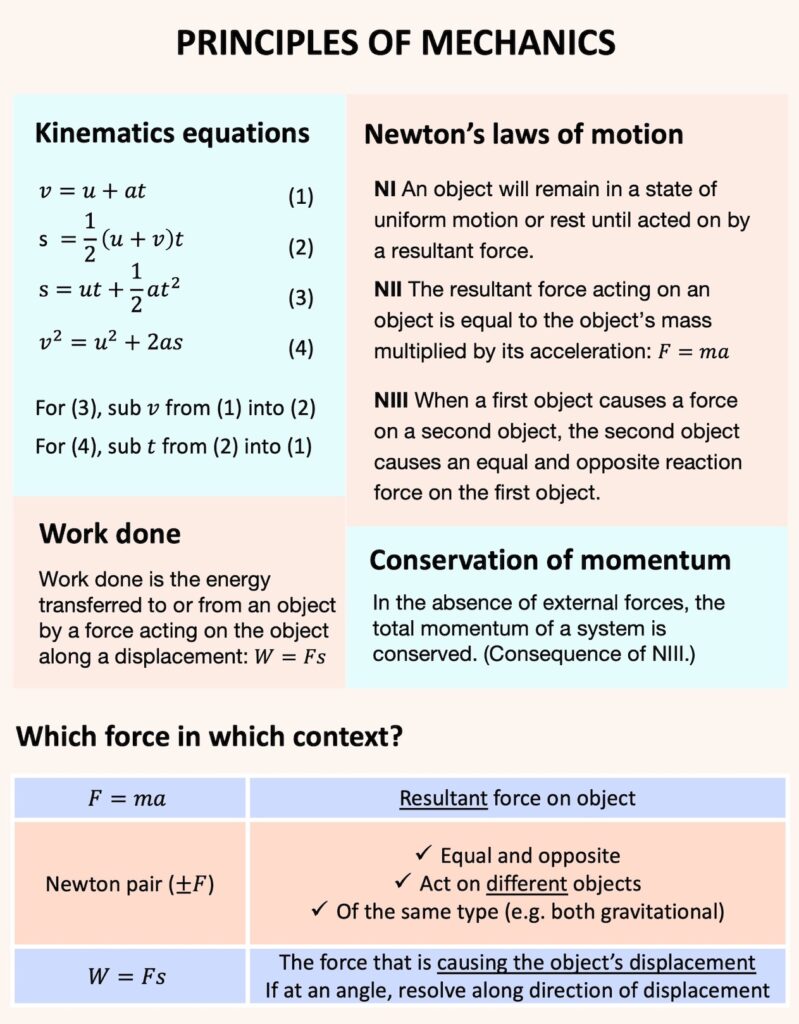
Here is a summary of the key takeaways from this topic:
Conclusion
I hope you’ve enjoyed this review of the principles of mechanics! We’ve covered the equations of motion, Newton’s laws of motion, the conservation of momentum, and work done. Getting a really clear understanding of these principles will give you a solid foundation for solving a wide range of problems.
Armed with this knowledge, you might like to explore some other mechanics topics too, such as graphs of motion for common scenarios, projectiles, work, energy and power, and moments and rotational equilibrium.
Happy studying!