
Contents
Introduction
In mechanics, an important sub-topic is that of energy, work done, and power.
In this post, we’re going to define the concept of work done and explore energy conservation, power and efficiency.
Let’s begin!
What is work?
Work done, or work, is the energy transferred to an object by a force acting on the object to make it move. Since work is an amount of energy, it is a scalar quantity measured in joules, \(\rm{J}\).
For example, consider a force \(F\) acting on an object to move it a distance \(s\):

The work done is the force resolved in the direction of the object’s motion multiplied by the distance through which the object moves:
\(W=Fs\cos\theta\)
Of course, when the force is in the same direction as the object’s motion, \(\theta=0^{\circ}\) and \(\cos \theta=1\), so work is simply equal to force multiplied by distance:
\(W=Fs\)
Examples of work done
In a first example, work is done pulling a trolley a distance \(x\).
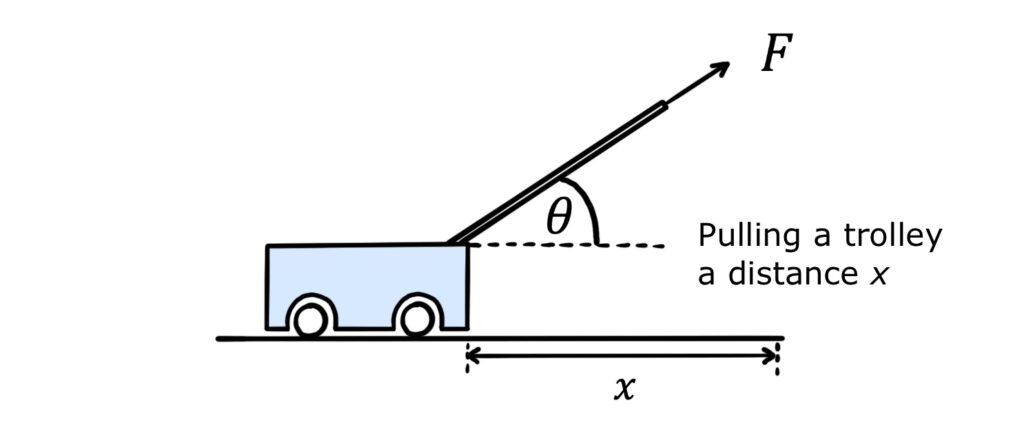
Resolving the force in the direction of motion and plugging in the distance \(s=x\), we have:
\(W=Fx\cos \theta\)
Easy!
In a second example, work is done raising a load of mass \(m\) through a height \(h\).
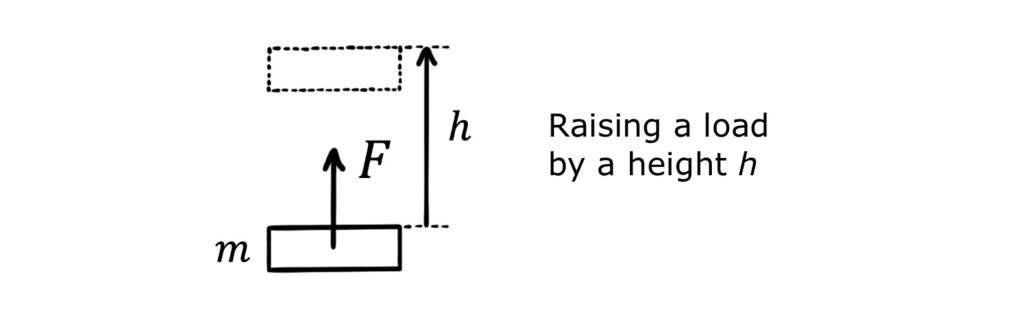
The force required to do the work has the same magnitude as the load’s weight because it must be just enough to counteract the weight. Since it acts in the direction of motion, \(\cos \theta=1\). So we have:
\(W=Fs\,cos\theta\)
\(=(mg)\times h \times 1\)
\(=mgh\)
Good stuff!
Now let’s try a third example in which work is done stretching a spring by an extension \(x\).

This one is a bit different because the force required to extend the spring is not constant, but proportional to the spring’s extension. So we must use an average force, \(F_{ave}\) (with \(\cos \theta=1\) since it acts in the direction of extension).
Work done is therefore:
\(W=Fs\,cos\theta\)
\(= F_{ave}x\)
A nice, simple expression.
Area under a force-displacement graph
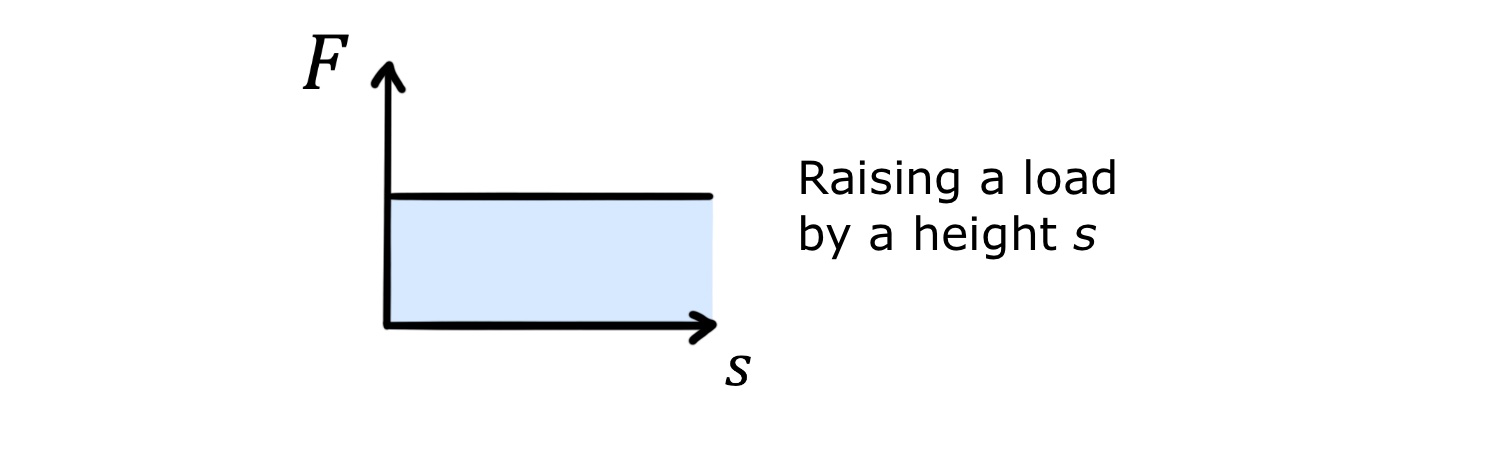
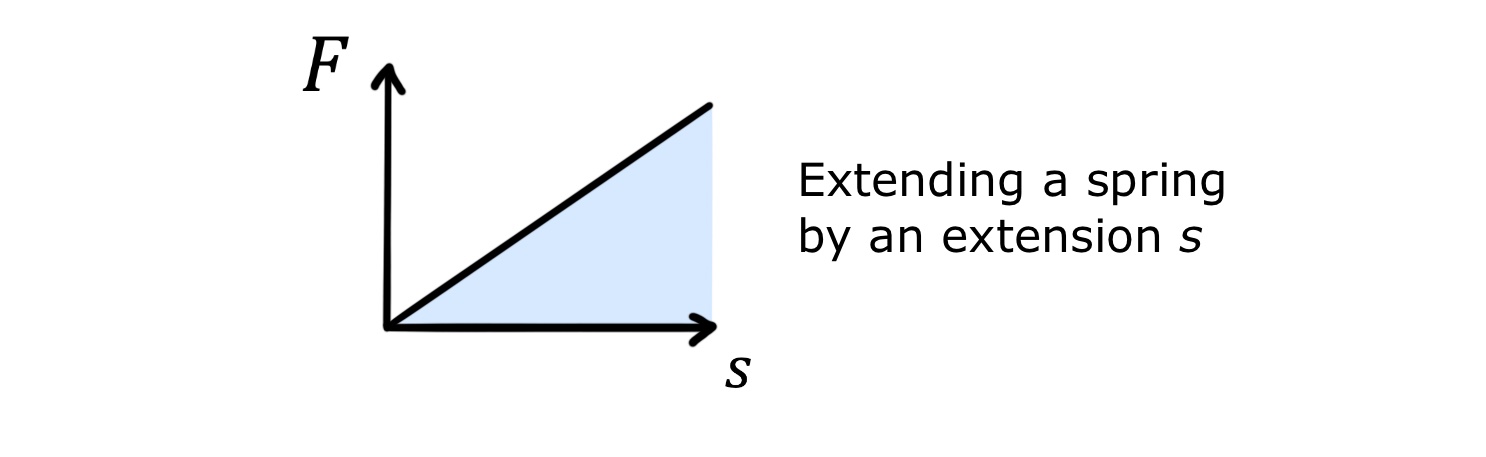
The area under a graph of force (resolved in the direction of the object’s motion) against distance moved is equal to the work done.
When force is constant, the work done is the area under the constant force line. For example, the work done raising a load by a height \(s\) is the area under the constant force line:
In the case of a variable force extending a spring, work done is equal the the area under the straight line of increasing force:
Transfers between different forms of energy
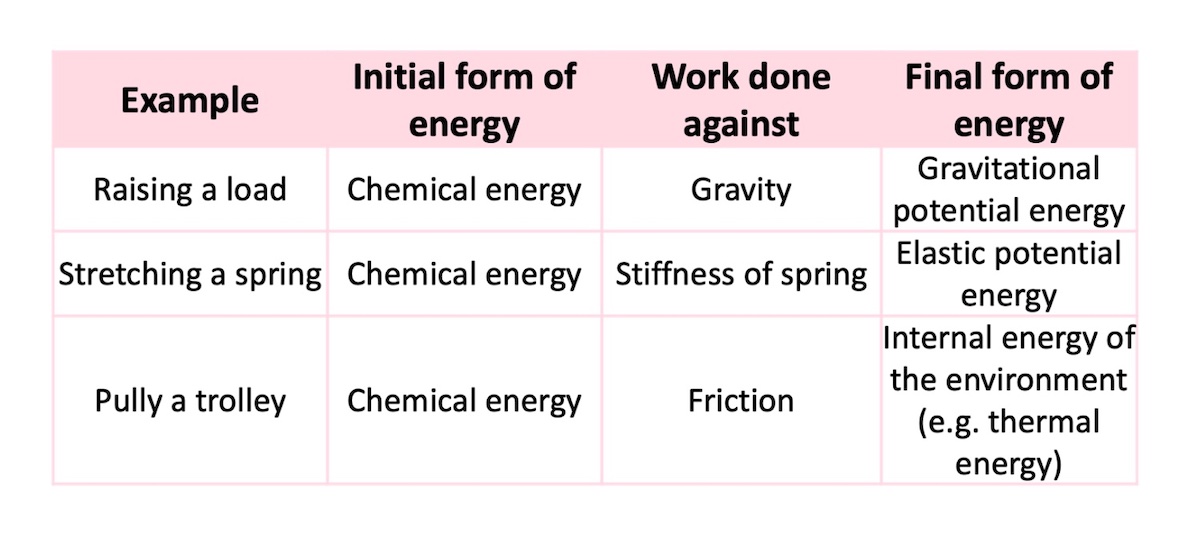
When work is done, energy is always transferred from one form to another. For example, a person might do work raising a load, stretching a spring, or pulling a trolley. The chemical energy stored in their muscles is transferred into other forms as follows:
In many common scenarios, an object’s energy is transferred between kinetic and gravitational potential forms:
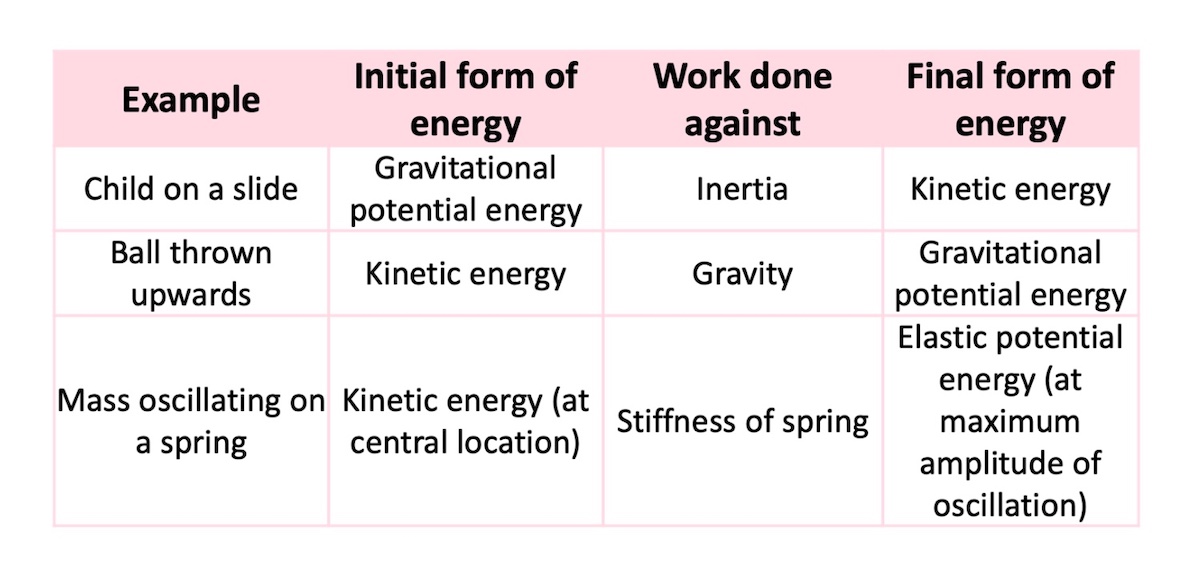
The main thing to remember is that when work is done, energy changes from one form to another!
The principle of conservation of energy
The principle of conservation of energy is a universal law with no exceptions. According to the principle of conservation of energy, energy cannot be created or destroyed. Rather, in a closed system, it can only be transferred from one form to another.
For example, a pendulum might oscillate with a smaller and smaller amplitude over time, but this does not mean that energy is disappearing. It is just being transferred to the internal energy of the environment because work is being done against air resistance and friction.
Even in nuclear reactions where energy is converted into mass, no energy is lost because mass is another form of energy (due to mass-energy equivalence).
Maximum speed of a pendulum
Conservation of energy allows us to do some nifty calculations.
In a classic example, a pendulum is raised to a height \(h\) above its lowest point and let go. We want to find its maximum speed (ignoring air resistance and any friction at the pivot).
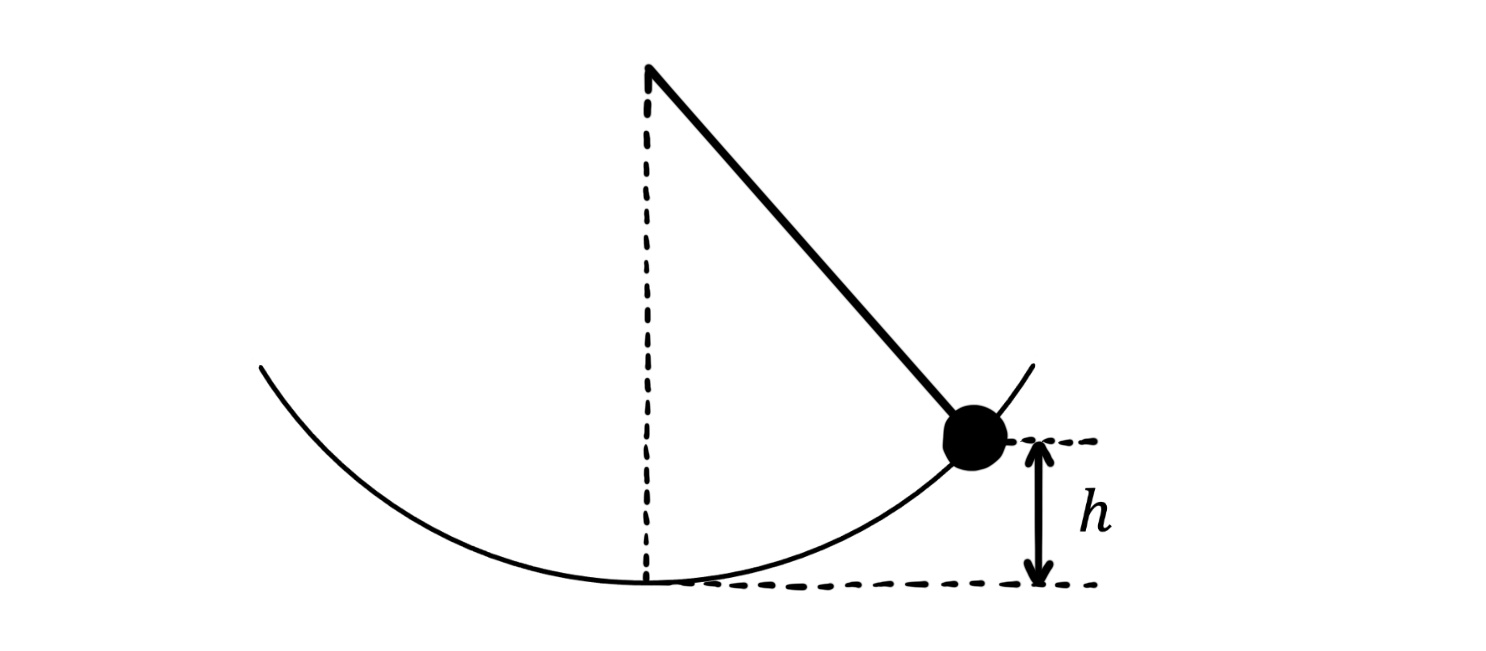
As it swings, its initial gravitational potential energy is converted into kinetic energy. Its maximum kinetic energy occurs at its lowest point, after which it swings back up and its kinetic energy is converted back into gravitational potential energy.
At its lowest point, its initial gravitational potential energy \(mgh\) has been converted into kinetic energy:
\(\frac{1}{2}mv_{max}^2=mgh\)
Cancelling \(m\) and rearranging, we have:
\(v_{max}^2=2gh\)
So the maximum speed of the pendulum is:
\(v_{max}=\sqrt{2gh}\)
Power
Power is the rate at which energy is transferred from one form to another. So it is equal to the rate of work done:
\(P=\frac{W}{t}\)
It has its own derived unit called the Watt which is equal to one Joule per second: \(1\rm{W}=1Js^{-1}\).
Since \(W=Fs\) (with \(F\) being the component of the force in the direction of the object’s motion), we can write:
\(P=\frac{W}{t}=\frac{Fs}{t}\)
However, \(\frac{s}{t}\) is the object’s velocity, so:
\(P=Fv\)
This is another handy expression for power.
Efficiency
The efficiency of a system is defined as the useful energy output expressed as a percentage of the energy input:
\(\rm{Efficiency}=\frac{Useful \,energy \,output}{Energy \, input} \times 100\)
Dividing the numerator and denominator by time gives us this alternative expression:
\(\rm{Efficiency}=\frac{Useful \,power \,output}{power \, input} \times 100\)
For example, using the first equation, if a motor transfers \(100\, \rm{J}\) of electrical energy to \(95\, \rm{J}\) of useful kinetic energy and \(5\,\rm{J}\) of energy is dissipated to the environment, then the efficiency of the motor is:
\(\frac{95\,\rm{J}}{100\,\rm{J}} \times 100=95\%\)
Note that efficiency can also be expressed as a fraction if we do not multiply the ratio by \(100\). For example, an efficiency of \(95\%\) could also be expressed as \(0.95\). Either way, efficiency is just a number and has no units.
In the example of the pendulum, work done by the pendulum against air resistance and friction is not useful and could be used in a calculation of the efficiency of the pendulum system.
Conclusion
I hope you’ve enjoyed this review of work, energy and power! This is an important area of mechanics with both mechanical and electrical applications.
If you’ve enjoyed this topic, you might also like to explore other mechanics topics such as the principles of mechanics, projectile motion, and moments and rotational equilibrium.
Happy studying!