
Contents
Introduction
The SI system of units provides a standardised way of expressing amounts of physical quantities. Understanding this system will enable you to express your calculated answers in full and with confidence.
In this blog post, we’re going to review base and derived units in the SI system, as well as looking at quantities with non-SI units or no units at all.
Let’s begin!
What are the SI base units?
SI units are standard units of measurement agreed by the international scientific community. ‘SI’ stands for ‘Système International’ which is French for ‘international system’.
The system has seven base units which are defined by reference to physical phenomena, and form the foundation of the system. All other SI units are formed by combining the base units.
The seven SI base units are the metre, kilogram, second, Ampère, Kelvin, mole and candela:
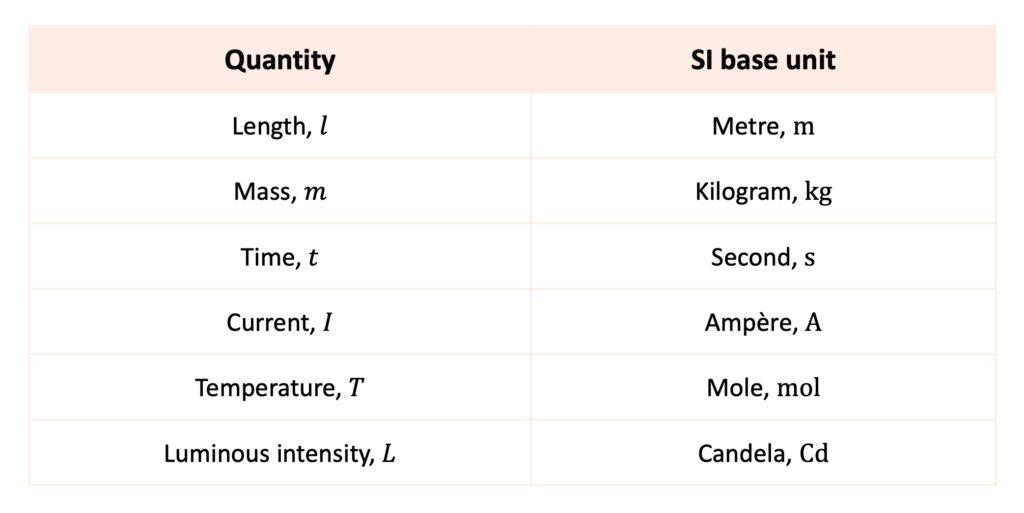
While you don’t need to know the definitions of the base units, a couple of examples are provided as follows to give you a feel for how they are defined:
- The second: \(9,192,631,770\) periods (\(T=\frac{1}{f}\)) of a photon having energy equal to the difference between two specific energy levels of a caesium-133 atom
- The meter: the distance travelled by light in a vacuum during \(\frac{1}{299,792,458}\) of a second (where the second is defined as above)
SI derived units
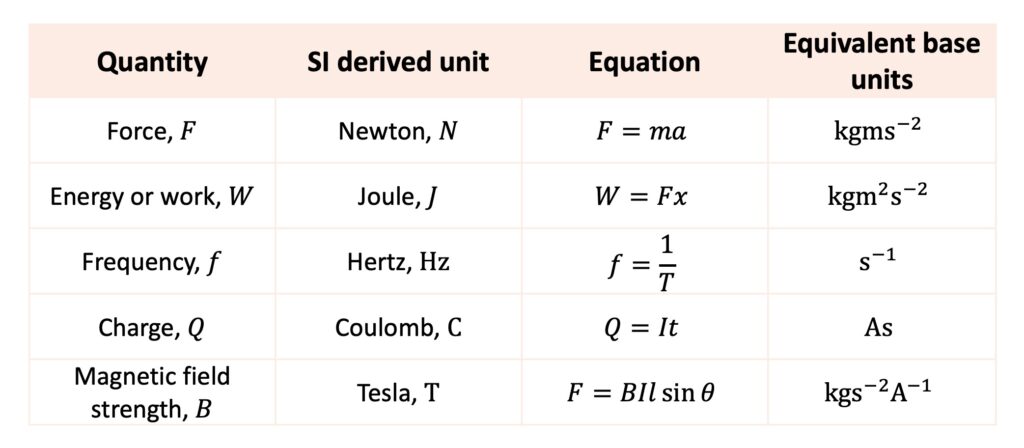
SI derived units are combinations of base units that have their own name and symbol.
For example, the Newton, \(\mathrm{N}\), is an SI derived unit. It can be expressed in terms of base units as the kilogram-metre-per-second-squared: \(\mathrm{kgms^{-2}}\).
How can we work out the equivalent base units?
This is easy using the equation for force. Since the Newton is the unit of force, we can use \(F=ma\) and balance the units on each side. One Newton is therefore equal to the unit of mass multiplied by the unit of acceleration: \(\mathrm{kg\times (ms^{-2}})=\mathrm{kgms^{-2}}\).
Here are a few more examples of quantities having SI derived units and the equation you need to work out their equivalent base units:
Quantities with combination units
Some quantities have units that are combinations of other units. These are very common!
For example, the unit of density, \(p=\frac{m}{V}\), is the unit of mass divided by the unit of volume: \(\mathrm{kgm^{-3}}\). This combines base units (the kilogram and the metre).
In another example, the unit of intensity, \(I=\frac{P}{A}\), is the unit of power divided by the unit of area: \(\mathrm{Wm^{-2}}\). This is a combination of a derived unit (the Watt) and a base unit (the metre).
I don’t recommend you necessarily learn all the combination units you come across because you can generally work them out from the quantity’s equation. However, familiarity with common ones is valuable and you should definitely learn your equations.
Non-SI units
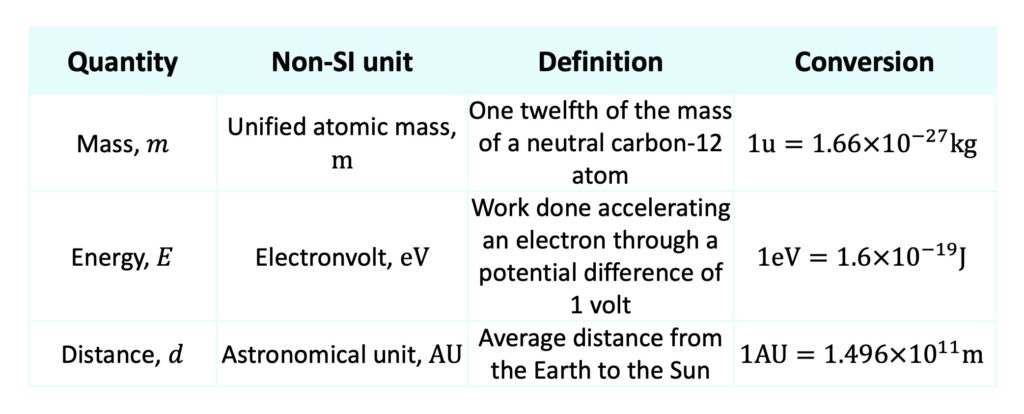
There are also units outside the SI system. Typically, these are for specialist areas of physics where very small or very large quantities are involved.
In nuclear physics, for example, particles have tiny masses. It would be inconvenient to deal with kilograms with are ridiculously large compared to tiny nucleons!
Instead, the unified atomic mass, \(\mathrm{u}\), is routinely used. This is defined as one twelfth of the mass of a neutral carbon-12 atom and is equivalent to \(1.66\times10^{-27}\mathrm{kg}\).
Other examples of specialised non-SI units arise in atomic physics for expressing small amounts of energy and in astrophysics for expressing large distances:
Prefixes
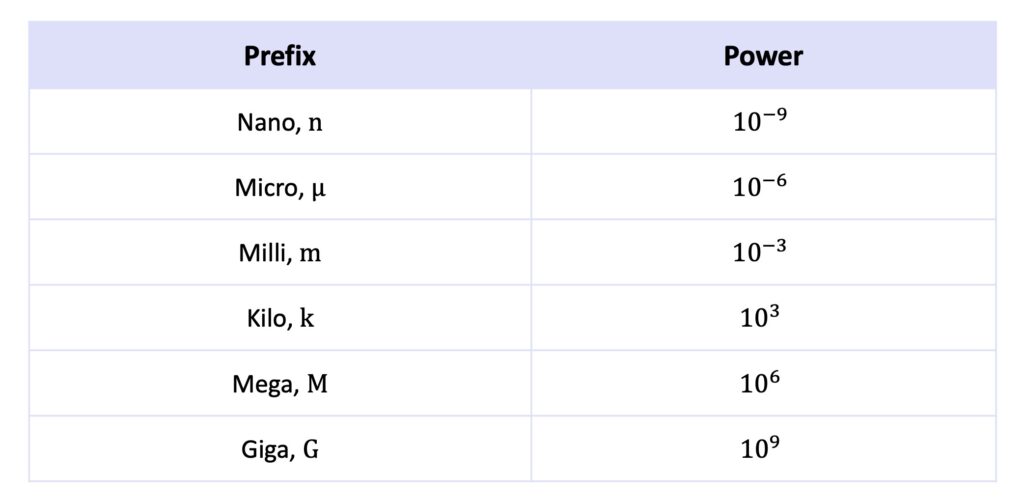
Finally, you should know at least the common prefixes used to express standard form notation from \(10^{-9}\) to \(10^{9}\).
Here they are!
Quantities with no units
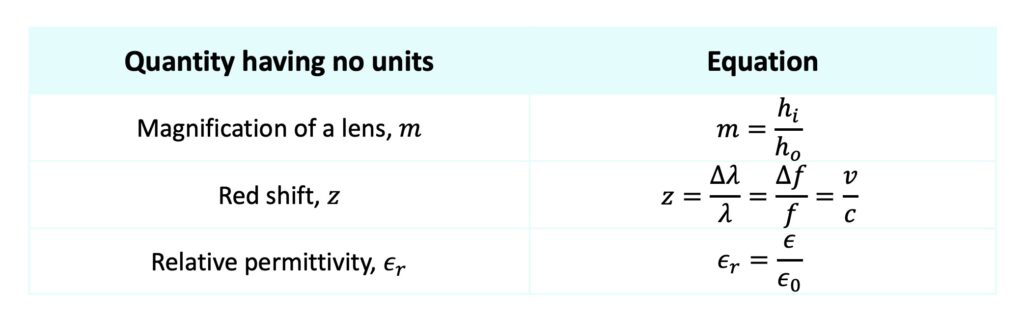
Let’s not forget that some quantities have no units at all! Typically, these arise when the definition of the quantity involves a ratio of two quantities having the same units (e.g. a ratio of lengths or a ratio of masses).
Here are some examples:
Summary
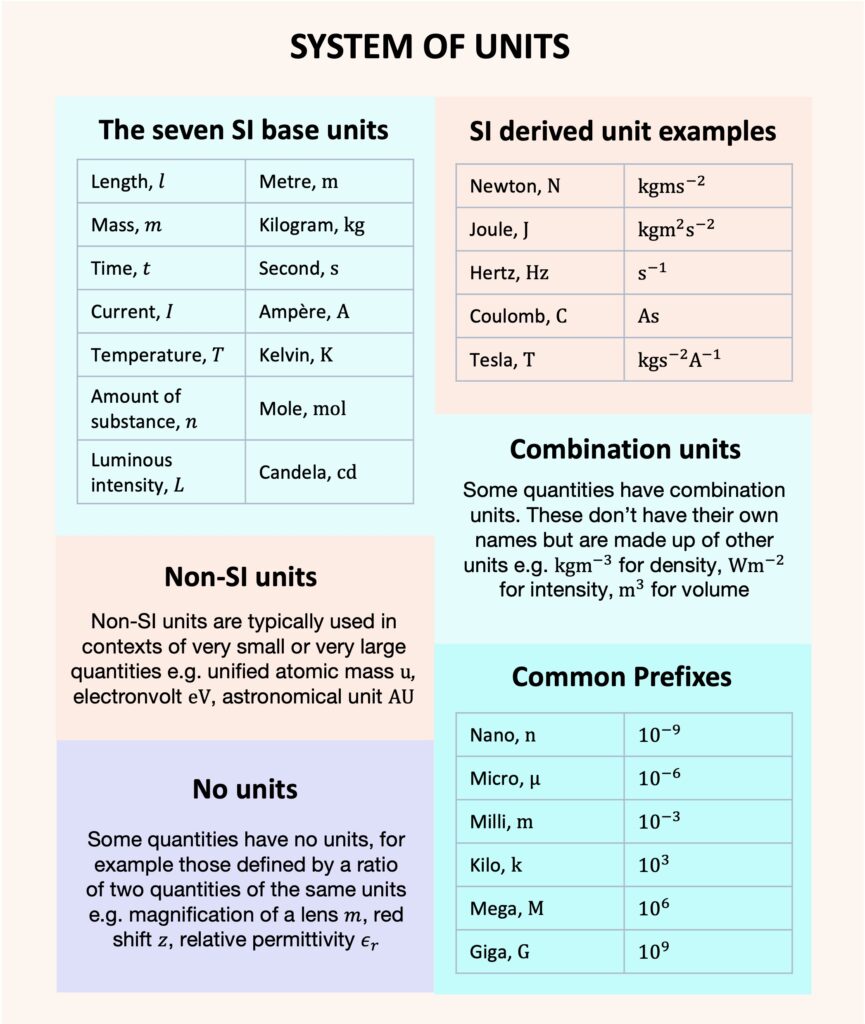
The key points to take away about the system of units are summarised as follows:
Conclusion
I hope you’ve enjoyed this review of the SI system of units! We’ve covered SI base units, derived units and combination units, and reviewed some quantities with non-SI units or no units at all.
If you’ve enjoyed this post, you may enjoy exploring the blog for more related A Level physics topics.
Happy studying!